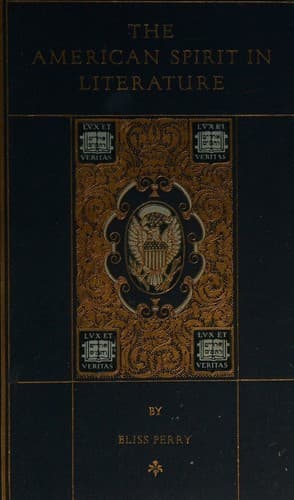
The American Spirit in Literature: A Chronicle of Great InterpretersPerry, Bliss
History
The American Spirit in Literature: A Chronicle of Great Interpreters
Perry, Bliss
American literature -- History and criticism
and political history, the New Hampshire boyhood and education, the rise
to mastery at the New England bar, the service in the House of
Representatives and the Senate and as Secretary of State. His speeches
were already in the schoolbooks, and for twenty years boys had been
declaiming his arguments against nullification. He had helped to teach
America to think and to feel. Indeed it was through his oratory that
many of his fellow-citizens had gained their highest conception of the
beauty, the potency, and the dignity of human speech. And in truth he
never exhibited his logical power and demonstrative skill more superbly
than in the plea of the seventh of March for the preservation of the
status quo, for the avoidance of mutual recrimination between North and
South, for obedience to the law of the land. It was his supreme effort
to reconcile an irreconcilable situation.
It failed, as we know. Whittier, Emerson, Theodore Parker, and indeed
most of the voters of New England, believed that Webster had bartered
his private convictions in the hope of securing the Presidential
nomination in 1852. They assailed him savagely, and Webster died, a
broken man, in the autumn of the Presidential year. "I have given my
life to law and politics," he wrote to Professor Silliman. "Law is
uncertain and politics are utterly vain." The dispassionate judgment of
the present hour frees him from the charge of conscious treachery to
principle. He was rather a martyr to his own conception of the
obligations imposed by nationality. When these obligations run counter
to human realities, the theories of statesmen must give way. Emerson
could not refute that logic of Webster's argument for the Fugitive Slave
Law, but he could at least record in his private Journal: "I will not
obey it, by God!" So said hundreds of thousands of obscure men in the
North, but Webster did not or could not hear them.
Public-domain text, read in full here on John Shaqi.
Reviews
Reviews
No reviews yet
Be the first to share your thoughts on this work.
Elsewhere in the archive
Join the Discussion
Join the discussion
Sign in to leave a comment or review.
Sign InorCreate an account