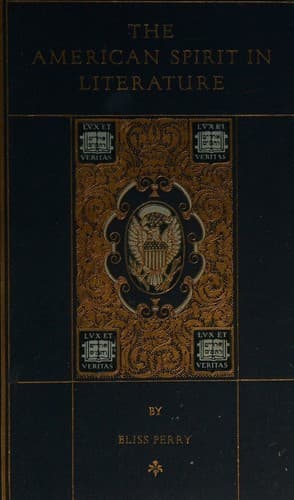
The American Spirit in Literature: A Chronicle of Great InterpretersPerry, Bliss
History
The American Spirit in Literature: A Chronicle of Great Interpreters
Perry, Bliss
American literature -- History and criticism
When Webster himself thundered, at the close of his reply to Hayne in
1830, "Union and Liberty, now and forever, one and inseparable," the
words sank deeper into the consciousness of the American people than any
similar sentiment uttered by Henry Clay. For Webster's was the richer,
fuller nature, nurtured by "the great books of the past," brooding, as
Lincoln was to brood later, over the seemingly insoluble problem of
preserving a union of States half slave, half free. On the fateful
seventh of March, 1850, Webster, like Clay, cast the immense weight of
his personality and prestige upon the side of compromise. It was the
ruin of his political fortune, for the mood of the North was changing,
and the South preferred other candidates for the Presidency. Yet the
worst that can fairly be said against that speech today is that it
lacked moral imagination to visualize, as Mrs. Stowe was soon to
visualize, the human results of slavery. As a plea for the transcendent
necessity of maintaining the old Union it was consistent with Webster's
whole development of political thought.
What were the secrets of that power that held Webster's hearers
literally spellbound, and made the North think of him, after that
alienation of 1850, as a fallen angel? No one can say fully, for we
touch here the mysteries of personality and of the spoken word. But
enough survives from the Webster legend, from his correspondence and
political and legal oratory, to bring us into the presence of a
superman. The dark Titan face, painted by such masters as Carlyle,
Hawthorne, and Emerson; the magical voice, remembered now but by a few
old men; the bodily presence, with its leonine suggestion of sleepy
power only half put forth--these aided Webster to awe men or allure them
into personal idolatry. Yet outside of New England he was admired rather
than loved. There is still universal recognition of the mental capacity
of this foremost lawyer and foremost statesman of his time. He was
unsurpassed in his skill for direct, simple, limpid statement; but he
could rise at will to a high Roman stateliness of diction, a splendid
sonorousness of cadence. His greatest public appearances were in the
Dartmouth College Case before the Supreme Court, the Plymouth, Bunker
Hill, and Adams-Jefferson commemorative orations, the Reply to Hayne,
and the Seventh of March speeches in the Senate. Though he exhibited in
his private life something of the prodigal recklessness of the pioneer,
his mental operations were conservative, constructive. His lifelong
antagonist Calhoun declared that "The United States are not a nation."
Webster, in opposition to this theory of a confederation of states,
devoted his superb talents to the demonstration of the thesis that the
United States "is," not "are." Thus he came to be known as the typical
expounder of the Constitution. When he reached, in 1850, the
turning-point of his career, his countrymen knew by heart his personal
Public-domain text, read in full here on John Shaqi.
Reviews
Reviews
No reviews yet
Be the first to share your thoughts on this work.
Elsewhere in the archive
Join the Discussion
Join the discussion
Sign in to leave a comment or review.
Sign InorCreate an account