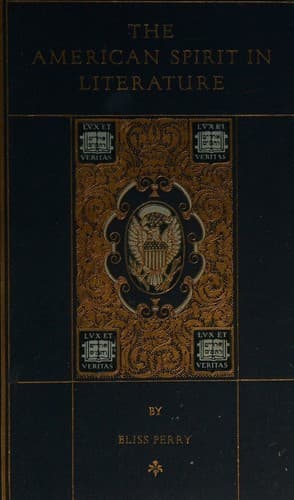
The American Spirit in Literature: A Chronicle of Great InterpretersPerry, Bliss
History
The American Spirit in Literature: A Chronicle of Great Interpreters
Perry, Bliss
American literature -- History and criticism
Let us begin with the West, and with that joyous stage-coach journey of
young Samuel L. Clemens across the plains to Nevada in 1861, which he
describes in Roughing It. Who was this Argonaut of the new era, and what
makes him representative of his countrymen in the epoch of release? Born
in Missouri in 1835, the son of an impractical emigrant from Virginia,
the youth had lived from his fourth until his eighteenth year on the
banks of the Mississippi. He had learned the printer's trade, had
wandered east and back again, had served for four years as a river-pilot
on the Mississippi, and had tried to enter the Confederate army. Then
came the six crowded years, chiefly as newspaper reporter, in the boom
times of Nevada and California. His fame began with the publication in
New York in 1867 of The Celebrated Jumping Frog of Calaveras County. A
newspaper now sent him to Europe to record "what he sees with his own
eyes." He did so in Innocents Abroad, and his countrymen shouted with
laughter. This, then, was "Europe" after all--another "fake" until this
shrewd river-pilot who signed himself "Mark Twain" took its soundings!
Then came a series of far greater books--Roughing It, Life on the
Mississippi, The Gilded Age (in collaboration), and Tom Sawyer and
Huckleberry Finn--books that make our American Odyssey, rich in the
spirit of romance and revealing the magic of the great river as no other
pages can ever do again. Gradually Mark Twain became a public character;
he retrieved on the lecture platform the loss of a fortune earned by his
books; he enjoyed his honorary D. Litt. from Oxford University. Every
reader of American periodicals came to recognize the photographs of that
thick shock of hair, those heavy eyebrows, the gallant drooping little
figure, the striking clothes, the inevitable cigar: all these things
seemed to go with the part of professional humorist, to be like the
caressing drawl of Mark's voice. The force of advertisement could no
further go. But at bottom he was far other than a mere maker of
boisterous jokes for people with frontier preferences in humor. He was a
passionate, chivalric lover of things fair and good, although too honest
to pretend to see beauty and goodness where he could not personally
detect them--and an equally passionate hater of evil. Read The Man Who
Corrupted Hadleyburg and The Mysterious Stranger. In his last years,
torn by private sorrows, he turned as black a philosophical pessimist as
we have bred. He died at his new country seat in Connecticut in 1910.
Mr. Paine has written his life in three great volumes, and there is a
twenty-five volume edition of his Works.
Public-domain text, read in full here on John Shaqi.
Reviews
Reviews
No reviews yet
Be the first to share your thoughts on this work.
Elsewhere in the archive
Join the Discussion
Join the discussion
Sign in to leave a comment or review.
Sign InorCreate an account