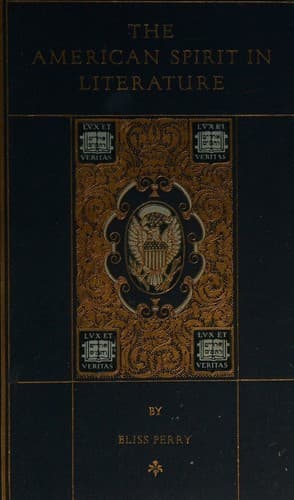
The American Spirit in Literature: A Chronicle of Great InterpretersPerry, Bliss
History
The American Spirit in Literature: A Chronicle of Great Interpreters
Perry, Bliss
American literature -- History and criticism
All the evidence seems to be in. Yet the verdict of the public seems not
quite made up. It is clear that Mark Twain the writer of romance is
gaining upon Mark Twain the humorist. The inexhaustible American
appetite for frontier types of humor seizes upon each new variety,
crunches it with huge satisfaction, and then tosses it away. John
Phoenix, Josh Billings, Jack Downing, Bill Arp, Petroleum V. Nasby,
Artemus Ward, Bill Nye--these are already obsolescent names. If Clemens
lacked something of Artemus Ward's whimsical delicacy and of Josh
Billings's tested human wisdom, he surpassed all of his competitors in a
certain rude, healthy masculinity, the humor of river and mining-camp
and printing-office, where men speak without censorship. His country-men
liked exaggeration, and he exaggerated; they liked irreverence, and he
had turned iconoclast in Innocents Abroad. As a professional humorist,
he has paid the obligatory tax for his extravagance, over-emphasis, and
undisciplined taste, but such faults are swiftly forgotten when one
turns to Huckleberry Finn and the negro Jim and Pudd'nhead Wilson, when
one feels Mark Twain's power in sheer description and episode, his magic
in evoking landscape and atmosphere, his blazing scorn at injustice and
cruelty, his contempt for quacks.
Bret Harte, another discoverer of the West, wears less well than Mark
Twain as a personal figure, but has a sure place in the evolution of the
American short story, and he did for the mining-camps of California what
Clemens wrought for the Mississippi River: he became their profane poet.
Yet he was never really of them. He was the clever outsider, with a
prospector's eye, looking for literary material, and finding a whole
rich mine of it--a bigger and richer, in fact, than he was really
qualified to work. But he located a golden vein of it with an instinct
that did credit to his dash of Hebrew blood. Born in Albany, a teacher's
son, brought up on books and in many cities, Harte emigrated to
California in 1854 at the age of sixteen. He became in turn a
drug-clerk, teacher, type-setter, editor, and even Secretary of the
California Mint--his nearest approach, apparently, to the actual work of
the mines. In 1868, while editor of The Overland Monthly, he wrote the
short story which was destined to make him famous in the East and to
release him from California forever. It was The Luck of Roaring Camp. He
had been writing romantic sketches in prose and verse for years; he had
steeped himself in Dickens, like everybody else in the eighteen-sixties;
and now he saw his pay-gravel shining back into his own shining eyes. It
was a pocket, perhaps, rather than a lead, but Bret Harte worked to the
end of his career this material furnished by the camps, this method of
the short story. He never returned to California after his joyous exit
in 1871. For a few years he tried living in New York, but from 1878
until his death in 1902 Bret Harte lived in Europe, still turning out
Public-domain text, read in full here on John Shaqi.
Reviews
Reviews
No reviews yet
Be the first to share your thoughts on this work.
Elsewhere in the archive
Join the Discussion
Join the discussion
Sign in to leave a comment or review.
Sign InorCreate an account