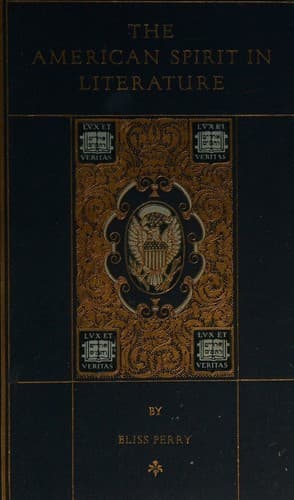
The American Spirit in Literature: A Chronicle of Great InterpretersPerry, Bliss
History
The American Spirit in Literature: A Chronicle of Great Interpreters
Perry, Bliss
American literature -- History and criticism
California stories for an English and American public which insisted
upon that particular pattern.
That the pattern was arbitrary, theatrical, sentimental, somewhat
meretricious in design, in a word insincere like its inventor, has been
repeated at due intervals ever since 1868. The charge is true; yet it is
far from the whole truth concerning Bret Harte's artistry. In mastery of
the technique of the short story he is fairly comparable with Poe,
though less original, for it was Poe who formulated, when Bret Harte was
a child of six, the well-known theory of the unity of effect of the
brief tale. This unity Harte secured through a simplification, often an
insulation, of his theme, the omission of quarreling details, an
atmosphere none the less novel for its occasional theatricality, and
characters cunningly modulated to the one note they were intended to
strike. Tennessee's Partner, The Outcast of Poker Flat, and all the rest
are triumphs of selective skill--as bright nuggets as ever glistened in
the pan at the end of a hard day's labor. That they do not adequately
represent the actual California of the fifties, as old Californians
obstinately insist, is doubtless true, but it is beside the point. Here
is no Tolstoi painting the soul of his race in a few pages: Harte is
simply a disciple of Poe and Dickens, turning the Poe construction trick
gracefully, with Dickensy characters and consistently romantic action.
The West has been rediscovered many a time since that decade which
witnessed the first literary bonanza of Mark Twain and Bret Harte. It
will continue to be discovered, in its fresh sources of appeal to the
imagination, as long as Plains and Rockies and Coast endure, as long as
there is any glow upon a distant horizon. It is not places that lose
romantic interest: the immemorial English counties and the Bay of Naples
offer themselves freely to the artist, generation after generation. What
is lost is the glamour of youth, the specific atmosphere of a given
historical epoch. Colonel W. F. Cody ("Buffalo Bill") has typified to
millions of American boys the great period of the Plains, with its
Indian fighting, its slaughter of buffaloes, its robbing of
stage-coaches, its superb riders etched against the sky. But the Wild
West was retreating, even in the days of Daniel Boone and Davy Crockett.
The West of the cowboys, as Theodore Roosevelt and Owen Wister knew it
and wrote of it in the eighties and nineties, has disappeared, though it
lives on in fiction and on the screen.
Public-domain text, read in full here on John Shaqi.
Reviews
Reviews
No reviews yet
Be the first to share your thoughts on this work.
Elsewhere in the archive
Join the Discussion
Join the discussion
Sign in to leave a comment or review.
Sign InorCreate an account