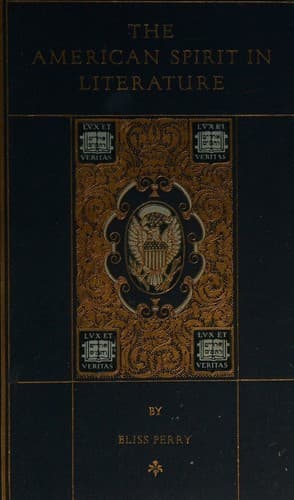
The American Spirit in Literature: A Chronicle of Great Interpreters — John Shaqi
The American Spirit in Literature: A Chronicle of Great InterpretersPerry, Bliss
History
The American Spirit in Literature: A Chronicle of Great Interpreters
Perry, Bliss
American literature -- History and criticism
But the slightest acquaintance with colonial writings will reveal the
fact that such political radicalism as Thomas Hooker's was accompanied
by an equally striking conservatism in other directions. One of these
conservative traits was the pioneer's respect for property, and
particularly for the land cleared by his own toil. Gladstone once spoke
of possession of the soil as the most important and most operative of
all social facts. Free-footed as the pioneer colonist was, he was
disinclined to part with his land without a substantial price for it.
The land at his disposal was practically illimitable, but he showed a
very English tenacity in safeguarding his hold upon his own portion.
Very English, likewise, was his attachment to the old country as "home."
The lighter and the more serious writings of the colonists are alike in
their respect for the past. In the New England settlements, although not
at first in Virginia, there was respect for learning and for an educated
clergy. The colonists revered the Bible. They maintained a stubborn
regard for the Common Law of England. Even amid all the excitement of a
successful rebellion from the mother country, this Common Law still held
the Americans to the experience of the inescapable past.
Indeed, as the reader of today lifts his eyes from the pages of the
books written in America during the seventeenth century, and tries to
meditate upon the general difference between them and the English books
written during the same period, he will be aware of the firmness with
which the conservative forces held on this side of the Atlantic. It was
only one hundred years from the Great Armada of 1588 to the flight of
James Second, the last of the Stuart Kings. With that Revolution of 1688
the struggles characteristic of the seventeenth century in England came
to an end. A new working basis is found for thought, politics, society,
literature. But while those vast changes had been shaking England, two
generations of American colonists had cleared their forests, fought the
savages, organized their townships and their trade, put money in their
purses, and lived, though as yet hardly suspecting it, a life that was
beginning to differentiate them from the men of the Old World. We must
now glance at the various aspects of this isolated life of theirs, as it
is revealed in their books.
CHAPTER II.
The First Colonial Literature
Public-domain text, read in full here on John Shaqi.
Reviews
Reviews
No reviews yet
Be the first to share your thoughts on this work.
Join the Discussion
Join the discussion
Sign in to leave a comment or review.
Sign InorCreate an account