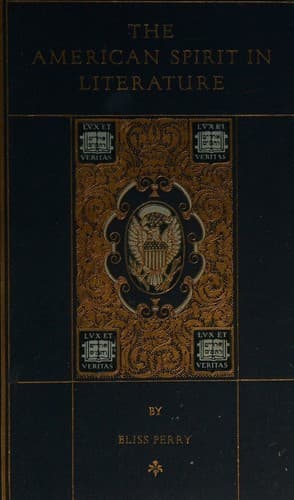
The American Spirit in Literature: A Chronicle of Great InterpretersPerry, Bliss
History
The American Spirit in Literature: A Chronicle of Great Interpreters
Perry, Bliss
American literature -- History and criticism
Perhaps the truth is that although we are a reading people we are not
yet a book-loving people. The American newspaper and magazine have been
successful in making their readers fancy that newspaper and magazine are
an equivalent for books. Popular orators and popular preachers confirm
this impression, and colleges and universities have often emphasized a
vocational choice of books--in other words, books that are not books at
all, but treatises. It is not, of course, that American journalism,
whether of the daily or monthly sort, has consciously set itself to
supplant the habit of book-reading. A thousand social and economic
factors enter into such a problem. But few observers will question the
assertion that the influence of the American magazine, ever since its
great period of national literary service in the eighties and nineties,
has been more marked in the field of conduct and of artistic taste than
in the stimulation of a critical literary judgment. An American
schoolhouse of today owes its improvement in appearance over the
schoolhouse of fifty years ago largely to the popular diffusion, through
the illustrated magazines, of better standards of artistic taste. But
whether the judgment of school-teachers and school-children upon a piece
of literature is any better than it was in the red schoolhouse of fifty
years ago is a disputable question.
But we must stop guessing, or we shall never have done. The fundamental
problem of our literature, as this book has attempted to trace it, has
been to obtain from a mixed population dwelling in sections as widely
separated as the peoples of Northern and Southern Europe, an integral
intellectual and spiritual activity which could express, in obedience to
the laws of beauty and truth, the emotions stimulated by our national
life. It has been assumed in the preceding chapters that American
literature is something different from English literature written in
America. Canadian and Australian literatures have indigenous qualities
of their own, but typically they belong to the colonial literature of
Great Britain. This can scarcely be said of the writings of Franklin and
Jefferson, and it certainly cannot be said of the writings of Cooper,
Hawthorne, Emerson, Thoreau, Whitman, Lowell, Lincoln, Mark Twain, and
Mr. Howells. In the pages of these men and of hundreds of others less
distinguished, there is a revelation of a new national type. That the
full energies of this nation have been back of our books, giving them a
range and vitality and unity commensurate with the national existence,
no one would claim. There are other spheres of effort in which American
character has been more adequately expressed than in words. Nevertheless
the books are here, in spite of every defect in national discipline,
every flaw in national character; and they deserve the closest attention
from all those who are trying to understand the American mind.
Public-domain text, read in full here on John Shaqi.
Reviews
Reviews
No reviews yet
Be the first to share your thoughts on this work.
Elsewhere in the archive
Join the Discussion
Join the discussion
Sign in to leave a comment or review.
Sign InorCreate an account