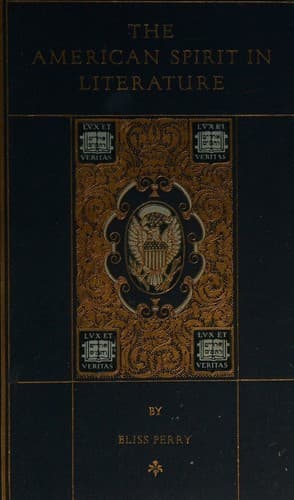
The American Spirit in Literature: A Chronicle of Great InterpretersPerry, Bliss
History
The American Spirit in Literature: A Chronicle of Great Interpreters
Perry, Bliss
American literature -- History and criticism
If the effort toward an expression of a peculiarly complex national
experience has been the problem of our literary past, the literary
problem of the future is the expression of the adjustment of American
ideals to the standards of civilization. "Patriotism," said the martyred
Edith Cavell just before her death, "is not enough." Nationality and the
instincts of national separatism now seem essential to the preservation
of the political units of the world-state, precisely as a healthy
individualism must be the basis of all enduring social fellowship. Yet
it is clear that civilization is a larger, more ultimate term than
nationality. Chauvinism is nowhere more repellent than in the things of
the mind. It is difficult for some Americans to think internationally
even in political affairs--to construe our national policy and duty in
terms of obligation to civilization. Nevertheless the task must be
faced, and we are slowly realizing it.
In the field of literature, likewise, Americanism is not a final word
either of blame or praise. It is a word of useful characterization. Only
American books, and not books written in English in America, can
adequately represent our national contribution to the world's thinking
and feeling. So argued Emerson and Whitman, long ago. But the younger of
these two poets came to realize in his old age that the New World and
the Old World are fundamentally one. The literature of the New World
will inevitably have an accent of its own, but it must speak the
mother-language of civilization, share in its culture, accept its
discipline.
It has been said disparagingly of Longfellow and his friends: "The
houses of the Brahmins had only eastern windows. The souls of the whole
school lived in the old lands of culture, and they visited these lands
as often as they could, and, returning, brought back whole libraries of
books which they eagerly translated." But even if Longfellow and his
friends had been nothing more than translators and diffusers of European
culture, their task would have been justified. They kept the ideals of
civilization from perishing in this new soil. Through those eastern
windows came in, and still comes in, the sunlight to illumine the
American spirit. To decry the literatures of the Orient and of Greece
and Rome as something now outgrown by America, is simply to close the
eastern windows, to narrow our conception of civilization to merely
national and contemporaneous terms. It is as provincial to attempt this
restriction in literature as it would be in world-politics. We must have
all the windows open in our American writing, free access to ideas,
knowledge of universal standards, perception of universal law.
BIBLIOGRAPHICAL NOTE
Public-domain text, read in full here on John Shaqi.
Reviews
Reviews
No reviews yet
Be the first to share your thoughts on this work.
Elsewhere in the archive
Join the Discussion
Join the discussion
Sign in to leave a comment or review.
Sign InorCreate an account