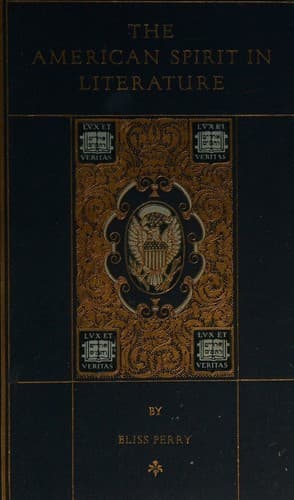
The American Spirit in Literature: A Chronicle of Great InterpretersPerry, Bliss
History
The American Spirit in Literature: A Chronicle of Great Interpreters
Perry, Bliss
American literature -- History and criticism
Yet it must be said that men like Hooker and Cotton, Shepard and Norton,
had every instinct and capacity for leadership. With the notable
exception of Hooker, such men were aristocrats, holding John Winthrop's
opinion that "Democracy is, among most civil nations, accounted the
meanest and worst form of government." They were fiercely intolerant.
The precise reason for the Hooker migration from Cambridge to Hartford
in 1636--the very year of the founding of Harvard--was prudently
withheld, but it is now thought to be the instinct of escape from the
clerical architects of the Cambridge Platform. Yet no one would today
call Thomas Hooker a liberal in religion, pioneer in political liberty
though he proved to be. His extant sermons have the steady stroke of a
great hammer; smiting at the mind and heart. "Others because they have
felt the heavy hand of God ... upon these grounds they build their
hopes: 'I have had my hell in this life, and I hope to have heaven in
the world to come; I hope the worst is over.'" Not so, thunders the
preacher in reply: "Sodom and Gomorrah they burnt in brimstone and they
shall burn in hell." One of Hooker's successors has called him "a son of
thunder and a son of consolation by turns." The same may be said of
Thomas Shepard, another graduate of Emmanuel College in the old
Cambridge, who became the "soul-melting preacher" of the newer Cambridge
by the Charles. Pure, ravishing notes of spiritual devotion still sing
themselves in his pages. He is wholly Calvinist. He thinks "the truth is
a poor mean thing in itself" and that the human reason cannot be "the
last resolution of all doubts," which must be sought only in the written
Word of God. He holds it "a tough work, a wonderful hard matter to be
saved." "Jesus Christ is not got with a wet finger." Yet, like so many
mystics, he yearns to be "covered with God, as with a cloud," to be
"drowned, plunged, and swallowed up with God." One hundred years later
we shall find this same rhapsodic ecstasy in the meditations of Jonathan
Edwards.
John Cotton, the third of the mighty men in the early Colonial pulpit,
owes his fame more to his social and political influence than to his
literary power. Yet even that was thought commanding. Trained, like
Hooker and Shepard, at Emmanuel College, and fresh from the rectorship
of St. Botolph's in the Lincolnshire Boston, John Cotton dominated that
new Boston which was named in his honor. He became the Pope of the
theocracy; a clever Pope and not an unkindly one. He seems to have
shared some of the opinions of Anne Hutchinson, though he "pronounced
the sentence of admonition" against her, says Winthrop, with much zeal
and detestation of her errors. Hawthorne, in one of his ironic moods,
might have done justice to this scene. Cotton was at heart too liberal
for his rôle of Primate, and fate led him to persecute a man whose very
name has become a symbol of victorious tolerance, Roger Williams.
Public-domain text, read in full here on John Shaqi.
Reviews
Reviews
No reviews yet
Be the first to share your thoughts on this work.
Join the Discussion
Join the discussion
Sign in to leave a comment or review.
Sign InorCreate an account