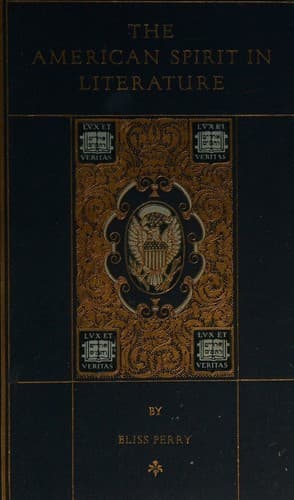
The American Spirit in Literature: A Chronicle of Great Interpreters — John Shaqi
The American Spirit in Literature: A Chronicle of Great InterpretersPerry, Bliss
History
The American Spirit in Literature: A Chronicle of Great Interpreters
Perry, Bliss
American literature -- History and criticism
One American, no doubt our most gifted man of letters of that century,
passed most of the Revolutionary period abroad, in the service of his
country. Benjamin Franklin was fifty-nine in the year of the Stamp Act.
When he returned from France in 1785 he was seventy-nine, but he was
still writing as admirably as ever when he died at eighty-four. We
cannot dismiss this singular, varied, and fascinating American better
than by quoting the letter which George Washington wrote to him in
September, 1789. It has the dignity and formality of the eighteenth
century, but it is warm with tested friendship and it glows with deep
human feeling: "If to be venerated for benevolence, if to be admired for
talents, if to be esteemed for patriotism, if to be beloved for
philanthropy, can gratify the human mind, you must have the pleasing
consolation to know that you have not lived in vain. And I flatter
myself that it will not be ranked among the least grateful occurrences
of your life to be assured, that, so long as I retain my memory, you
will be recollected with respect, veneration, and affection by your
sincere friend, George Washington."
There remains another Virginian, the symbol of the Revolutionary age,
the author of words more widely known around the globe than any other
words penned by an American. "Thomas Jefferson," writes the latest of
his successors in the Presidency, "was not a man of the people, but he
was a man of such singular insight that he saw that all the roots of
generous power come from the people." On his father's side Jefferson
came from sound yeoman stock, in which Welsh blood ran. His mother was a
Virginia Randolph. Born in Albemarle County, near the "little
mountain"--Monticello--where he built a mansion for his bride and where
he lies buried, the tall, strong, red-haired, gray-eyed, gifted boy was
reputed the best shot, the best rider, the best fiddle-player in the
county. He studied hard at William and Mary over his Greek, Latin,
French, Italian, and Spanish, but he also frequented the best society of
the little capital. He learned to call himself a Deist and to theorize
about ideal commonwealths. There was already in him that latent
radicalism which made him strike down, as soon as he had the power, two
of the fundamental principles of the society into which he was born, the
principle of entailed property and that of church establishment.
Such was the youth of twenty-two who was thrilled in 1765 by the Stamp
Act. In the ten years of passionate discussion which followed, two
things became clear: first, that there had long existed among the
colonists very radical theoretical notions of political freedom; and
second, that there was everywhere a spirit of practical conservatism.
Jefferson illustrates the union of these two tendencies.
Public-domain text, read in full here on John Shaqi.
Reviews
Reviews
No reviews yet
Be the first to share your thoughts on this work.
Join the Discussion
Join the discussion
Sign in to leave a comment or review.
Sign InorCreate an account