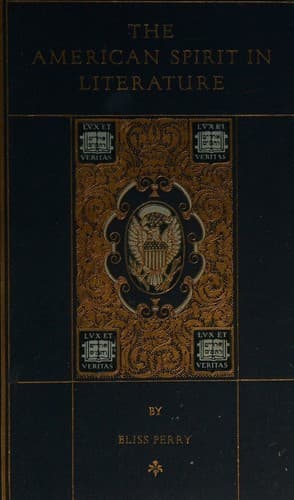
The American Spirit in Literature: A Chronicle of Great Interpreters — John Shaqi
The American Spirit in Literature: A Chronicle of Great InterpretersPerry, Bliss
History
The American Spirit in Literature: A Chronicle of Great Interpreters
Perry, Bliss
American literature -- History and criticism
The historian of literature is bound to take account of this question of
literary vogue, as it is highly significant of the temper of successive
generations in any country. But it is of peculiar interest to the
student of the literature produced in the United States. Is this
literature "American," or is it "English literature in America," as
Professor Wendell and other scholars have preferred to call it? I should
be one of the last to minimize the enormous influence of England upon
the mind and the writing of all the English-speaking countries of the
globe. Yet it will be one of the purposes of the present book to
indicate the existence here, even in colonial times, of a point of view
differing from that of the mother country, and destined to differ
increasingly with the lapse of time. Since the formation of our Federal
Union, in particular, the books produced in the United States have
tended to exhibit certain characteristics which differentiate them from
the books produced in other English-speaking countries. We must beware,
of course, of what the late Charles Francis Adams once called the
"filiopietistic" fallacy. The "American" qualities of our literature
must be judged in connection with its conformity to universal standards
of excellence. Tested by any universal standard, The Scarlet Letter is a
notable romance. It has won a secure place among the literature written
by men of English blood and speech. Yet to overlook the peculiarly local
or provincial characteristics of this remarkable story is to miss the
secret of its inspiration. It could have been written only by a New
Englander, in the atmosphere of a certain epoch.
Our task, then, in this rapid review of the chief interpreters of the
American spirit in literature, is a twofold one. We are primarily
concerned with a procession of men, each of whom is interesting as an
individual and as a writer. But we cannot watch the individuals long
without perceiving the general direction of their march, the ideas that
animate them, the common hopes and loyalties that make up the life of
their spirit. To become aware of these general tendencies is to
understand the "American" note in our national writing.
Public-domain text, read in full here on John Shaqi.
Reviews
Reviews
No reviews yet
Be the first to share your thoughts on this work.
Join the Discussion
Join the discussion
Sign in to leave a comment or review.
Sign InorCreate an account