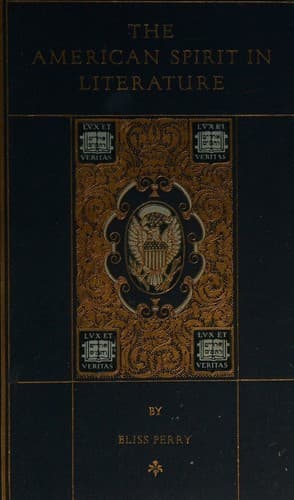
The American Spirit in Literature: A Chronicle of Great InterpretersPerry, Bliss
History
The American Spirit in Literature: A Chronicle of Great Interpreters
Perry, Bliss
American literature -- History and criticism
Then, beginning in the eighteen-twenties, and developing rapidly after
1830, came a change, a change so startling as to warrant the term of
"the Renascence of New England." No single cause is sufficient to
account for this "new birth." It is a good illustration of that law of
"tension and release," which the late Professor Shaler liked to
demonstrate in all organic life. A long period of strain was followed by
an age of expansion, freedom, release of energy. As far as the mental
life of New England was concerned, something of the new stimulus was due
directly to the influence of Europe. Just as the wandering scholars from
Italy had brought the New Learning, which was a revival of the old
learning, into England in the sixteenth century, so now young New
England college men like Edward Everett and George Ticknor brought home
from the Continent the riches of German and French scholarship.
Emerson's description of the impression made by Everett's lectures in
1820, after his return from Germany, gives a vivid picture of the new
thirst for foreign culture. The North American Review and other
periodicals, while persistently urging the need of a distinctively
national literature, insisted also upon the value of a deeper knowledge
of the literature of the Continent. This was the burden of Channing's
once famous article on A National Literature in 1823: it was a plea for
an independent American school of writers, but these writers should know
the best that Europe had to teach.
The purely literary movement was connected, as the great name of
Channing suggests, with a new sense of freedom in philosophy and
religion. Calvinism had mainly done its work in New England. It had bred
an extraordinary type of men and women, it had helped to lay some of
the permanent foundations of our democracy, and it was still destined to
have a long life in the new West and in the South. But in that stern
section of the country where its influence had been most marked there
was now an increasingly sharp reaction against its determinism and its
pessimism. Early in the nineteenth century the most ancient and
influential churches in Boston and the leading professors at Harvard had
accepted the new form of religious liberalism known as Unitarianism. The
movement spread throughout Eastern Massachusetts and made its way to
other States. Orthodox and liberal Congregational churches split apart,
and when Channing preached the ordination sermon for Jared Sparks in
Baltimore in 1819, the word Unitarian, accepted by the liberals with
some misgiving, became the recognized motto of the new creed. It is only
with its literary influence that we are here concerned, yet that
literary influence became so potent that there is scarcely a New England
writer of the first rank, from Bryant onward, who remained untouched by
it.
Public-domain text, read in full here on John Shaqi.
Reviews
Reviews
No reviews yet
Be the first to share your thoughts on this work.
Elsewhere in the archive
Join the Discussion
Join the discussion
Sign in to leave a comment or review.
Sign InorCreate an account