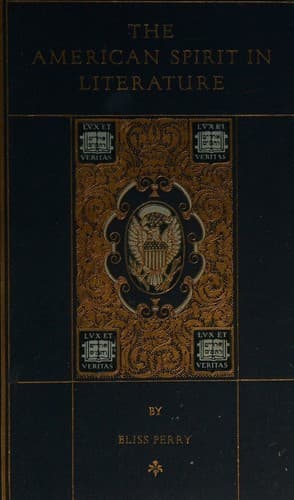
The American Spirit in Literature: A Chronicle of Great InterpretersPerry, Bliss
History
The American Spirit in Literature: A Chronicle of Great Interpreters
Perry, Bliss
American literature -- History and criticism
The most interesting and peculiar phase of the new liberalism has little
directly to do with the specific tenets of theological Unitarianism, and
in fact marked a revolt against the more prosaic and conventional
pattern of English and American Unitarian thought. But this movement,
known as Transcendentalism, would have been impossible without a
preliminary and liberalizing stirring of the soil. It was a fascinating
moment of release for some of the most brilliant and radical minds of
New England. Its foremost representative in our literature was Ralph
Waldo Emerson, as its chief exponents in England were Coleridge and
Carlyle. We must understand its meaning if we would perceive the quality
of much of the most noble and beautiful writing produced in New England
during the Golden Age.
What then is the significance of the word Transcendental? Disregarding
for the moment the technical development of this term as used by German
and English philosophers, it meant for Emerson and his friends simply
this: whatever transcends or goes beyond the experience of the senses.
It stressed intuition rather than sensation, direct perception of
ultimate truth rather than the processes of logic. It believed in man's
ability to apprehend the absolute ideas of Truth, Rectitude, Goodness.
It resembled the Inner Light of the Quaker, though the Quaker traced
this to a supernatural illumination of the Holy Spirit, while the
Transcendentalist believed that a vision of the eternal realities was a
natural endowment of the human mind. It had only to be trusted. Stated
in this form, it is evident that we have here a very ancient doctrine,
well known in the literature of India and of Greece. It has been held by
countless persons who have never heard of the word Transcendentalism. We
need go no further back than Alexander Pope, a Roman Catholic, whom we
find declaring: "I am so certain of the soul's being immortal that I
seem to feel it within me, as it were by intuition." Pope's friend
Swift, a dean of the Church of England and assuredly no
Transcendentalist, defined vision as seeing the things that are
invisible.
Now turn to some of the New England men. Dr. C. A. Bartol, a disciple of
Emerson, maintained that "the mistake is to make the everlasting things
subjects of argument instead of sight." Theodore Parker declared to his
congregation:
Public-domain text, read in full here on John Shaqi.
Reviews
Reviews
No reviews yet
Be the first to share your thoughts on this work.
Elsewhere in the archive
Join the Discussion
Join the discussion
Sign in to leave a comment or review.
Sign InorCreate an account