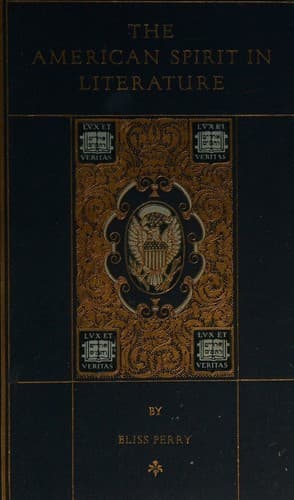
The American Spirit in Literature: A Chronicle of Great InterpretersPerry, Bliss
History
The American Spirit in Literature: A Chronicle of Great Interpreters
Perry, Bliss
American literature -- History and criticism
From the primitive facts of consciousness given by the power of
instinctive intuition, I endeavored to deduce the true notion of God, of
justice and futurity.... I found most help in the works of Immanuel
Kant, one of the profoundest thinkers of the world, though one of the
worst writers, even in Germany; if he did not always furnish conclusions
I could rest in, he yet gave me the true method, and put me on the right
road. I found certain great primal Intuitions of Human Nature, which
depend on no logical process of demonstration, but are rather facts of
consciousness given by the instinctive action of human nature itself. I
will mention only the three most important which pertain to Religion. 1.
The Instinctive Intuition of the Divine, the consciousness that there is
a God. 2. The Instinctive Intuition of the Just and Right, a
consciousness that there is a Moral Law, independent of our will, which
we ought to keep. 3. The Instinctive Intuition of the Immortal, a
consciousness that the Essential Element of man, the principle of
Individuality, never dies.
This passage dates from 1859, and readers of Bergson may like to compare
it with the contemporary Frenchman's saying: "The analytical faculties
can give us no realities."
Let us next hear Emerson himself, first in an early letter to his
brother Edward: "Do you draw the distinction of Milton, Coleridge, and
the Germans between Reason and Understanding? I think it a philosophy
itself, and, like all truth, very practical. Reason is the highest
faculty of the soul, what we mean often by the soul itself: it never
reasons, never proves, it simply perceives, it is vision. The
understanding toils all the time, compares, contrives, adds, argues;
near-sighted, but strong-sighted, dwelling in the present, the
expedient, the customary." And in 1833, after he had left the Unitarian
pulpit, Emerson made in his diary this curious attempt to reconcile the
scriptural language of his ancestral profession to the new vocabulary of
Transcendentalism: "Jesus Christ was a minister of the pure Reason. The
beatitudes of the Sermon on the Mount are all utterances of the mind
contemning the phenomenal world.... The understanding can make nothing
of it. 'Tis all nonsense. The Reason affirms its absolute verity.... St.
Paul marks the distinction by the terms natural man and spiritual man.
When Novalis says, 'It is the instinct of the Understanding to
contradict the Reason,' he only translates into a scientific formula the
doctrine of St. Paul, 'The Carnal Mind is enmity against God.'"
One more quotation must suffice. It is from a poem by a forgotten
Transcendentalist, F. G. Tuckerman.
No more thy meaning seek, thine anguish plead;
But, leaving straining thought and stammering word,
Across the barren azure pass to God;
Shooting the void in silence, like a bird--
A bird that shuts his wings for better speed!
Public-domain text, read in full here on John Shaqi.
Reviews
Reviews
No reviews yet
Be the first to share your thoughts on this work.
Elsewhere in the archive
Join the Discussion
Join the discussion
Sign in to leave a comment or review.
Sign InorCreate an account