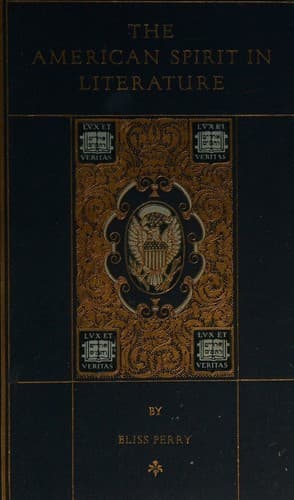
The American Spirit in Literature: A Chronicle of Great InterpretersPerry, Bliss
History
The American Spirit in Literature: A Chronicle of Great Interpreters
Perry, Bliss
American literature -- History and criticism
The pilgrim to Concord who stops for a moment in the village library to
study French's statue of Emerson will notice the asymmetrical face. On
one side it is the face of a keen Yankee farmer, but seen from the other
side it is the countenance of a seer, a world's man. This contrast
between the parochial Emerson and the greater Emerson interprets many a
puzzle in his career. Half a mile beyond the village green to the north,
close to the "rude bridge" of the famous Concord fight in 1775, is the
Old Manse, once tenanted and described by Hawthorne. It was built by
Emerson's grandfather, a patriot chaplain in the Revolution, who died of
camp-fever at Ticonderoga. His widow married Dr. Ezra Ripley, and here
Ralph Waldo Emerson and his brothers passed many a summer in their
childhood. Half a mile east of the village, on the Cambridge turnpike,
is Emerson's own house, still sheltered by the pines which Thoreau
helped him to plant in 1838. Within the house everything is unchanged:
here are the worn books, pen and inkstand, the favorite pictures upon
the wall. Over the ridge to the north lies the Sleepy Hollow cemetery
where the poet rests, with the gravestones of Hawthorne and the Alcotts,
Thoreau and William James close by.
But although Concord is the Emerson shrine, he was born in Boston, in
1803. His father, named William like the grandfather, was also, like the
Emerson ancestors for many generations, a clergyman--eloquent, liberal,
fond of books and music, highly honored by his alma mater Harvard and by
the town of Boston, where he ministered to the First Church. His
premature death in 1811 left his widow with five sons--one of them
feebleminded--and a daughter to struggle hard with poverty. With her
husband's sister, the Calvinistic "Aunt Mary Moody" Emerson, she held,
however, that these orphaned boys had been "born to be educated." And
educated the "eager blushing boys" were, at the Boston Latin School and
at Harvard College, on a regimen of "toil and want and truth and mutual
faith." There are many worse systems of pedagogy than this. Ralph was
thought less persistent than his steady older brother William, and far
less brilliant than his gifted, short-lived younger brothers, Edward and
Charles. He had an undistinguished career at Harvard, where he was
graduated in 1821, ranking thirtieth in a class of fifty-nine. Lovers of
irony like to remember that he was the seventh choice of his classmates
for the position of class poet. After some desultory teaching to help
his brothers, he passed irregularly through the Divinity School, his
studies often interrupted by serious ill-health. "If they had examined
me," he said afterward of the kindly professors in the Divinity School,
"they never would have passed me." But approve him they did, in 1826,
and he entered decorously upon the profession of his ancestors, as
associate minister of the Second Church in Boston. His Journals, which
are a priceless record of his inner life, at this and later periods,
Public-domain text, read in full here on John Shaqi.
Reviews
Reviews
No reviews yet
Be the first to share your thoughts on this work.
Elsewhere in the archive
Join the Discussion
Join the discussion
Sign in to leave a comment or review.
Sign InorCreate an account