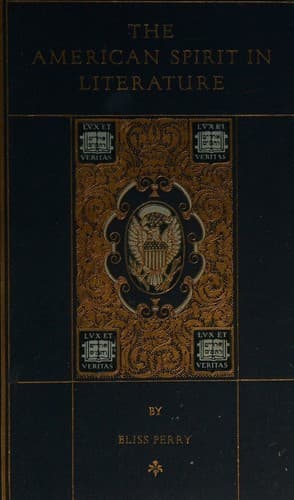
The American Spirit in Literature: A Chronicle of Great InterpretersPerry, Bliss
History
The American Spirit in Literature: A Chronicle of Great Interpreters
Perry, Bliss
American literature -- History and criticism
It is obvious that this "contemning the phenomenal world," this
"revulsion against the intellect as the sole source of truth," is highly
dangerous to second-class minds. If one habitually prints the words
Insight, Instinct, Intuition, Consciousness with capitals, and relegates
equally useful words like senses, experience, fact, logic to lower-case
type, one may do it because he is a Carlyle or an Emerson, but the
chances are that he is neither. Transcendentalism, like all idealistic
movements, had its "lunatic fringe," its camp-followers of excitable,
unstable visionaries. The very name, like the name Methodist, was
probably bestowed upon it in mockery, and this whole perturbation of
staid New England had its humorous side. Witness the career of Bronson
Alcott. It is also true that the glorious affirmations of these seers
can be neither proved nor disproved. They made no examination and they
sought no validation of consciousness. An explorer in search of the
North Pole must bring back proofs of his journey, but when a
Transcendentalist affirms that he has reached the far heights of human
experience and even caught sight of the gods sitting on their thrones,
you and I are obliged to take his word for it. Sometimes we hear such a
man gladly, but it depends upon the man, not upon the trustworthiness of
the method. Finally it should be observed that the Transcendental
movement was an exceedingly complex one, being both literary,
philosophic, and religious; related also to the subtle thought of the
Orient, to mediæval mysticism, and to the English Platonists; touched
throughout by the French Revolutionary theories, by the Romantic spirit,
by the new zeal for science and pseudo-science, and by the unrest of a
fermenting age.
Our present concern is with the impact of this cosmopolitan current upon
the mind and character of a few New England writers. Channing and
Theodore Parker, Margaret Fuller and Alcott, Thoreau and Emerson, are
all representative of the best thought and the noblest ethical impulses
of their generation. Let us choose first the greatest name: a
sunward-gazing spirit, and, it may be, one of the very Sun-Gods.
Public-domain text, read in full here on John Shaqi.
Reviews
Reviews
No reviews yet
Be the first to share your thoughts on this work.
Elsewhere in the archive
Join the Discussion
Join the discussion
Sign in to leave a comment or review.
Sign InorCreate an account