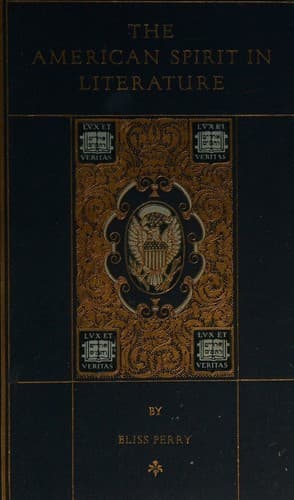
The American Spirit in Literature: A Chronicle of Great InterpretersPerry, Bliss
History
The American Spirit in Literature: A Chronicle of Great Interpreters
Perry, Bliss
American literature -- History and criticism
In 1837 he delivered the well-known Phi Beta Kappa oration at Harvard on
The American Scholar. Emerson was now thirty-four; he had married a
second time, had bought a house of his own in Concord, and purposed to
make a living by lecturing and writing. His address in Cambridge, though
it contained no reference to himself, was after all a justification of
the way of life he had chosen: a declaration of intellectual
independence for himself and his countrymen, an exhortation of
self-trust to the individual thinking man. "If the single man plant
himself indomitably on his instincts and there abide, the huge world
will come round to him." Such advice to cut loose from the moorings of
the past was not unknown in Phi Beta Kappa orations, though it had never
been so brilliantly phrased; but when Emerson applied precisely the same
doctrine, in 1838, to the graduating class at the Harvard Divinity
School, he roused a storm of disapproval. "A tempest in our washbowl,"
he wrote coolly to Carlyle, but it was more than that. The great
sentence of the Divinity School address, "God is, not was; he speaketh,
not spake," was the emphasis of a superb rhetorician upon the immediacy
of the soul's access to God. It has been the burden of a thousand
prophets in all religions. The young priests of the Divinity School,
their eyes wearied with Hebrew and Greek, seem to have enjoyed Emerson's
injunction to turn away from past records and historical authorities and
to drink from the living fountain of the divine within themselves; but
to the professors, "the stern old war-gods," this relative belittlement
of historical Christianity seemed blasphemy. A generation passed before
Emerson was again welcomed by his alma mater.
Public-domain text, read in full here on John Shaqi.
Reviews
Reviews
No reviews yet
Be the first to share your thoughts on this work.
Elsewhere in the archive
Join the Discussion
Join the discussion
Sign in to leave a comment or review.
Sign InorCreate an account