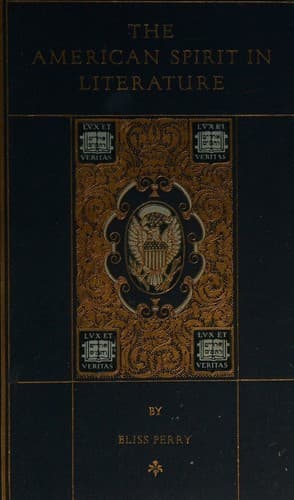
The American Spirit in Literature: A Chronicle of Great InterpretersPerry, Bliss
History
The American Spirit in Literature: A Chronicle of Great Interpreters
Perry, Bliss
American literature -- History and criticism
The reader who has mastered those three utterances by the Concord
Transcendentalist in 1836, 1837, and 1838 has the key to Emerson. He was
a seer, not a system-maker. The constitution of his mind forbade formal,
consecutive, logical thought. He was not a philosopher in the accepted
sense, though he was always philosophizing, nor a metaphysician in spite
of his curious searchings in the realm of metaphysics. He sauntered in
books as he sauntered by Walden Pond, in quest of what interested him;
he "fished in Montaigne," he said, as he fished in Plato and Goethe. He
basketed the day's luck, good or bad as it might be, into the pages of
his private Journal, which he called his savings-bank, because from this
source he drew most of the material for his books. The Journal has
recently been printed, in ten volumes. No American writing rewards the
reader more richly. It must be remembered that Emerson's Essays, the
first volume of which appeared in 1841, and the last volumes after his
death in 1882, represent practically three stages of composition: first
the detached thoughts of the Journal; second, the rearrangement of this
material for use upon the lecture platform; and finally, the essays in
their present form. The oral method thus predominates: a series of
oracular thoughts has been shaped for oratorical utterance, not
oratorical in the bombastic, popular American sense, but cunningly
designed, by a master of rhetoric, to capture the ear and then the mind
of the auditor.
Emerson's work as a lecturer coincided with the rise of that Lyceum
system which brought most of the American authors, for more than a
generation, into intimate contact with the public, and which proved an
important factor in the æsthetic and moral cultivation of our people. No
lecturer could have had a more auspicious influence than Emerson, with
his quiet dignity, his serene spiritual presence, his tonic and often
electrifying force. But if he gave his audiences precious gifts, he also
learned much from them. For thirty years his lecturing trips to the West
brought him, more widely than any New England man of letters, into
contact with the new, virile America of the great Mississippi valley.
Unlike many of his friends, he was not repelled by the "Jacksonism of
the West"; he rated it a wholesome, vivifying force in our national
thought and life. The Journal reveals the essential soundness of his
Americanism. Though surrounded all his life by reformers, he was himself
scarcely a reformer, save upon the single issue of anti-slavery. Perhaps
he was at bottom too much of a radical to be swept off his feet by any
reform.
Public-domain text, read in full here on John Shaqi.
Reviews
Reviews
No reviews yet
Be the first to share your thoughts on this work.
Elsewhere in the archive
Join the Discussion
Join the discussion
Sign in to leave a comment or review.
Sign InorCreate an account