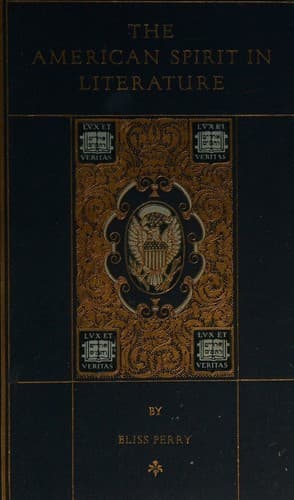
The American Spirit in Literature: A Chronicle of Great InterpretersPerry, Bliss
History
The American Spirit in Literature: A Chronicle of Great Interpreters
Perry, Bliss
American literature -- History and criticism
That the pure, high, and tonic mind of Emerson was universal in its
survey of human forces, no one would claim. Certain limitations in
interest and sympathy are obvious. "That horrid burden and impediment of
the soul which the churches call sin," to use John Morley's words,
occupied his attention but little. Like a mountain climber in a perilous
pass, he preferred to look up rather than down. He does not stress
particularly those old human words, service and sacrifice.
"Anti-scientific, anti-social, anti-Christian" are the terms applied to
him by one of his most penetrating critics. Yet I should prefer to say
"un-scientific," "un-social," and "non-Christian," in the sense in which
Plato and Isaiah are non-Christian. Perhaps it would be still nearer the
truth to say, as Mrs. Lincoln said of her husband, "He was not a
technical Christian." He tends to underestimate institutions of every
kind; history, except as a storehouse of anecdote, and culture as a
steady mental discipline. This is the price he pays for his
transcendental insistence upon the supreme value of the Now, the moment
of insight. But after all these limitations are properly set down, the
personality of Ralph Waldo Emerson remains a priceless possession to his
countrymen. The austere serenity of his life, and the perfection with
which he represents the highest type of his province and his era, will
ultimately become blended with the thought of his true Americanism. A
democrat and liberator, like Lincoln, he seems also destined like
Lincoln to become increasingly a world's figure, a friend and guide to
aspiring spirits everywhere. Differences of race and creed are
negligible in the presence of such superb confidence in God and the soul.
Citizens of Concord in May, 1862, hearing that Henry Thoreau, the
eccentric bachelor, had just died of consumption in his mother's house
on Main Street, in his forty-fifth year, would have smiled cannily at
the notion that after fifty years their townsman's literary works would
be published in a sumptuous twenty-volume edition, and that critics in
his own country and in Europe would rank him with Ralph Waldo Emerson.
Yet that is precisely what has happened. Our literature has no more
curious story than the evolution of this local crank into his rightful
place of mastership. In his lifetime he printed only two books, A Week
on the Concord and Merrimac Rivers--which was even more completely
neglected by the public than Emerson's Nature--and Walden, now one of
the classics, but only beginning to be talked about when its shy, proud
author penned his last line and died with the words "moose" and "Indian"
on his lips.
Public-domain text, read in full here on John Shaqi.
Reviews
Reviews
No reviews yet
Be the first to share your thoughts on this work.
Elsewhere in the archive
Join the Discussion
Join the discussion
Sign in to leave a comment or review.
Sign InorCreate an account