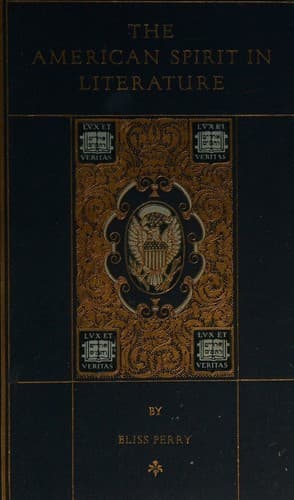
The American Spirit in Literature: A Chronicle of Great InterpretersPerry, Bliss
History
The American Spirit in Literature: A Chronicle of Great Interpreters
Perry, Bliss
American literature -- History and criticism
To our generation, of course, Emerson presents himself as an author of
books, and primarily as an essayist, rather than as a winning,
entrancing speaker. His essays have a greater variety of tone than is
commonly recognized. Many of them, like Manners, Farming, Books,
Eloquence, Old Age, exhibit a shrewd prudential wisdom, a sort of Yankee
instinct for "the milk in the pan," that reminds one of Ben Franklin.
Like most of the greater New England writers, he could be, on occasion,
an admirable local historian. See his essays on Life and Letters in New
England, New England Reformers, Politics, and the successive entries in
his Journal relating to Daniel Webster. He had the happiest gift of
portraiture, as is witnessed by his sketches of Montaigne, of Napoleon,
of Socrates (in the essay on Plato), of his aunt Mary Moody Emerson, of
Thoreau, and of various types of Englishmen in his English Traits. But
the great essays, no doubt, are those like Self-Reliance, Compensation,
The Over-Soul, Fate, Power, Culture, Worship, and Illusions. These will
puzzle no one who has read carefully that first book on Nature. They all
preach the gospel of intuition, instinctive trust in the Universe, faith
in the ecstatic moment of vision into the things that are unseen by the
physical eye. Self-reliance, as Emerson's son has pointed out, means
really God-reliance; the Over-Soul--always a stumbling-block to
Philistines--means that high spiritual life into which all men may enter
and in which they share the life of Deity. Emerson is stern enough in
expounding the laws of compensation that run through the universe, but
to him the chief law is the law of the ever-ascending, victorious soul.
This radiant optimism permeates his poems. By temperament a singer as
well as a seer and sayer, Emerson was nevertheless deficient in the
singing voice. He composed no one great poem, his verse presents no
ideas that are not found in his prose. In metre and rhyme he is harsh
and willful. Yet he has marvelous single phrases and cadences. He
ejaculates transports and ecstasies, and though he cannot organize and
construct in verse, he is capable here and there of the true miracle of
transforming fact and thought into true beauty. Aldrich used to say that
he would rather have written Emerson's Bacchus than any American poem.
Public-domain text, read in full here on John Shaqi.
Reviews
Reviews
No reviews yet
Be the first to share your thoughts on this work.
Elsewhere in the archive
Join the Discussion
Join the discussion
Sign in to leave a comment or review.
Sign InorCreate an account