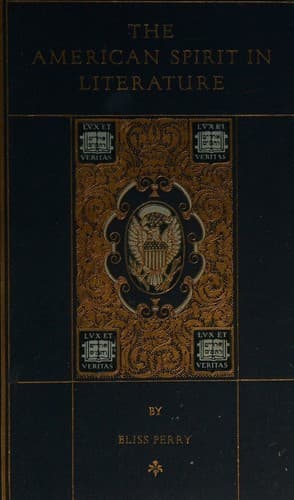
The American Spirit in Literature: A Chronicle of Great InterpretersPerry, Bliss
History
The American Spirit in Literature: A Chronicle of Great Interpreters
Perry, Bliss
American literature -- History and criticism
But while these three figures were, after Emerson and Thoreau, the most
representative of the group, the student of the Transcendental period
will be equally interested in watching its influence upon many other
types of young men: upon future journalists and publicists like George
William Curtis, Charles A. Dana, and George Ripley; upon religionists
like Orestes Brownson, Father Hecker, and James Freeman Clarke; and upon
poets like Jones Very, Christopher P. Cranch, and Ellery Channing. There
was a sunny side of the whole movement, as T. W. Higginson and F. B.
Sanborn, two of the latest survivors of the ferment, loved to emphasize
in their talk and in their books; and it was shadowed also by tragedy
and the pathos of unfulfilled desires. But as one looks back at it, in
the perspective of three-quarters of a century, it seems chiefly
something touchingly fine. For all these men and women tried to hitch
their wagon to a star.
CHAPTER VII.
Romance, Poetry, and History
Moving in and out of the Transcendentalist circles, in that great
generation preceding the Civil War, were a company of other
men--romancers, poets, essayists, historians--who shared in the
intellectual liberalism of the age, but who were more purely artists in
prose and verse than they were seekers after the unattainable.
Hawthorne, for example, sojourned at Concord and at Brook Farm with some
of the most extreme types of transcendental extravagance. The movement
interested him artistically and he utilized it in his romances, but
personally he maintained an attitude of cool detachment from it.
Longfellow was too much of an artist to lose his head over philosophical
abstractions; Whittier, at his best, had a too genuine poetic instinct
for the concrete; and Lowell and Holmes had the saving gift of humor.
Cultivated Boston gentlemen like Prescott, Motley, and Parkman preferred
to keep their feet on the solid earth and write admirable histories. So
the mellow years went by. Most of the widely-read American books were
being produced within twenty miles of the Boston State House. The
slavery issue kept growling, far away, but it was only now and then, as
in the enforcement of the Fugitive Slave Act of 1850, that it was
brought sharply home to the North. The "golden forties" were as truly
golden for New England as for idle California. There was wealth,
leisure, books, a glow of harvest-time in the air, though the spirit of
the writers is the spirit of youth.
Public-domain text, read in full here on John Shaqi.
Reviews
Reviews
No reviews yet
Be the first to share your thoughts on this work.
Elsewhere in the archive
Join the Discussion
Join the discussion
Sign in to leave a comment or review.
Sign InorCreate an account