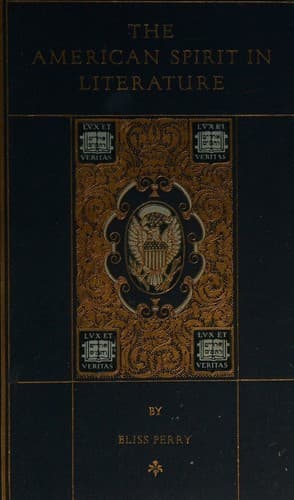
The American Spirit in Literature: A Chronicle of Great InterpretersPerry, Bliss
History
The American Spirit in Literature: A Chronicle of Great Interpreters
Perry, Bliss
American literature -- History and criticism
Nathaniel Hawthorne, our greatest writer of pure romance, was Puritan by
inheritance and temperament, though not in doctrine or in sympathy. His
literary affiliations were with the English and German Romanticists, and
he possessed, for professional use, the ideas and vocabulary of his
transcendental friends. Born in Salem in 1804, he was descended from
Judge Hawthorne of Salem Witchcraft fame, and from a long line of
sea-faring ancestors. He inherited a morbid solitariness, redeemed in
some measure by a physical endowment of rare strength and beauty. He
read Spenser, Rousseau, and the Newgate Calendar, was graduated at
Bowdoin, with Longfellow, in the class of 1825, and returned to Salem
for thirteen brooding lonely years in which he tried to teach himself
the art of story-writing. His earliest tales, like Irving's, are essays
in which characters emerge; he is absorbed in finding a setting for a
preconceived "moral"; he is in love with allegory and parable. His own
words about his first collection of stories, Twice-Told Tales, have
often been quoted: "They have the pale tint of flowers that blossomed in
too retired a shade." Yet they are for the most part exquisitely
written. After a couple of years in the Boston Custom-House, and a
residence at the socialistic community of Brook Farm, Hawthorne made the
happiest of marriages to Sophia Peabody, and for nearly four years dwelt
in the Old Manse at Concord. He described it in one of the ripest of his
essays, the Preface to Mosses from an Old Manse, his second collection
of stories. After three years in the Custom-House at Salem, his
dismissal in 1849 gave him leisure to produce his masterpiece, The
Scarlet Letter, published in 1850. He was now forty-six. In 1851, he
published The House of the Seven Gables, The Wonder-Book, and The
Snow-Image, and Other Tales. In 1852 came The Blithedale Romance, a rich
ironical story drawn from his Brook Farm experience. Four years in the
American Consulate at Liverpool and three subsequent years of residence
upon the Continent saw no literary harvest except carefully filled
notebooks and the deeply imaginative moral romance, The Marble Faun.
Hawthorne returned home in 1860 and settled in the Wayside at Concord,
busying himself with a new, and, as was destined, a never completed
story about the elixir of immortality. But his vitality was ebbing, and
in May, 1864, he passed away in his sleep. He rests under the pines in
Sleepy Hollow, near the Alcotts and the Emersons.
Public-domain text, read in full here on John Shaqi.
Reviews
Reviews
No reviews yet
Be the first to share your thoughts on this work.
Elsewhere in the archive
Join the Discussion
Join the discussion
Sign in to leave a comment or review.
Sign InorCreate an account