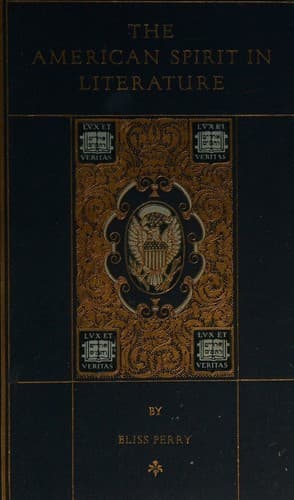
The American Spirit in Literature: A Chronicle of Great InterpretersPerry, Bliss
History
The American Spirit in Literature: A Chronicle of Great Interpreters
Perry, Bliss
American literature -- History and criticism
There is, then, a predisposition, a latent or potential Americanism
which existed long before the United States came into being. Now that
our political unity has become a fact, the predisposition is certain to
be regarded by our own and by future generations as evidence of a state
of mind which made our separate national life inevitable. Yet to Thomas
Hutchinson, a sound historian and honest man, the last Royal Governor of
Massachusetts, a separate national life seemed in 1770 an unspeakable
error and calamity.
The seventeenth-century colonists were predominantly English, in blood,
in traditions, and in impulses. Whether we look at Virginia or Plymouth
or at the other colonies that were planted in swift succession along the
seaboard, it is clear that we are dealing primarily with men of the
English race. Most of them would have declared, with as much emphasis as
Francis Hopkinson a century later, "We of America are in all respects
Englishmen." Professor Edward Channing thinks that it took a century of
exposure to colonial conditions to force the English in America away
from the traditions and ideals of those who continued to live in the old
land. But the student of literature must keep constantly in mind that
these English colonizers represented no single type of the national
character. There were many men of many minds even within the contracted
cabin of the Mayflower. The "sifted wheat" was by no means all of the
same variety.
For Old England was never more torn by divergent thought and subversive
act than in the period between the death of Elizabeth in 1603 and the
Revolution of 1688. In this distracted time who could say what was
really "English"? Was it James the First or Raleigh? Archbishop Laud or
John Cotton? Charles the First or Cromwell? Charles the Second or
William Penn? Was it Churchman, Presbyterian, Independent, Separatist,
Quaker? One is tempted to say that the title of Ben Jonson's comedy
Every Man in his Humour became the standard of action for two whole
generations of Englishmen, and that there is no common denominator for
emigrants of such varied pattern as Smith and Sandys of Virginia, Morton
of Merrymount, John Winthrop, "Sir" Christopher Gardiner and Anne
Hutchinson of Boston, and Roger Williams of Providence. They seem as
miscellaneous as "Kitchener's Army."
Public-domain text, read in full here on John Shaqi.
Reviews
Reviews
No reviews yet
Be the first to share your thoughts on this work.
Join the Discussion
Join the discussion
Sign in to leave a comment or review.
Sign InorCreate an account