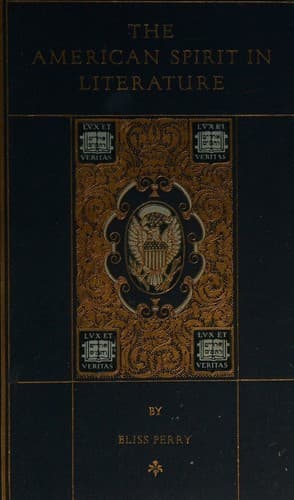
The American Spirit in Literature: A Chronicle of Great InterpretersPerry, Bliss
History
The American Spirit in Literature: A Chronicle of Great Interpreters
Perry, Bliss
American literature -- History and criticism
It is difficult for contemporary Americans to assess the value of such a
man, who evidently did nothing except to write a few books. His rare,
delicate genius was scarcely touched by passing events. Not many of his
countrymen really love his writings, as they love, for instance the
writings of Dickens or Thackeray or Stevenson. Everyone reads, at some
time of his life, The Scarlet Letter, and trembles at its passionate
indictment of the sin of concealment, at its agonized admonition, "Be
true! Be true!" Perhaps the happiest memories of Hawthorne's readers, as
of Kipling's readers, hover about his charming stories for children; to
have missed The Wonder-Book is like having grown old without ever
catching the sweetness of the green world at dawn. But our public has
learned to enjoy a wholly different kind of style, taught by the daily
journals, a nervous, graphic, sensational, physical style, fit for
describing an automobile, a department store, a steamship, a lynching
party. It is the style of our day, and judged by it Hawthorne, who wrote
with severity, conscience, and good taste, seems somewhat old-fashioned,
like Irving or Addison. He is perhaps too completely a New Englander to
be understood by men of other stock, and has never, like Poe and
Whitman, excited strong interest among European minds.
Yet no American is surer, generation after generation, of finding a fit
audience. Hawthorne's genius was meditative rather than dramatic. His
artistic material was moral rather than physical; he brooded over the
soul of man as affected by this and that condition and situation. The
child of a new analytical age, he thought out with rigid accuracy the
precise circumstances surrounding each one of his cases and modifying
it. Many of his sketches and short stories and most of his romances deal
with historical facts, moods, and atmospheres, and he knew the past of
New England as few men have ever known it. There is solid historical and
psychological stuff as the foundation of his air-castles. His latent
radicalism furnished him with a touchstone of criticism as he
interpreted the moral standards of ancient communities; no reader of The
Scarlet Letter can forget Hawthorne's implicit condemnation of the
unimaginative harshness of the Puritans. His own judgment upon the deep
matters of the human conscience was stern enough, but it was a
universalized judgment, and by no means the result of a Calvinism which
he hated. Over-fond as he was in his earlier tales of elaborate,
fanciful, decorative treatment of themes that promised to point a moral,
in his finest short stories, such as The Ambitious Guest, The Gentle
Boy, Young Goodman Brown, The Snow Image, The Great Stone Face, Drowne's
Wooden Image, Rappacini's Daughter, the moral, if there be one, is not
obtruded. He loves physical symbols for mental and moral states, and was
poet and Transcendentalist enough to retain his youthful affection for
Public-domain text, read in full here on John Shaqi.
Reviews
Reviews
No reviews yet
Be the first to share your thoughts on this work.
Elsewhere in the archive
Join the Discussion
Join the discussion
Sign in to leave a comment or review.
Sign InorCreate an account