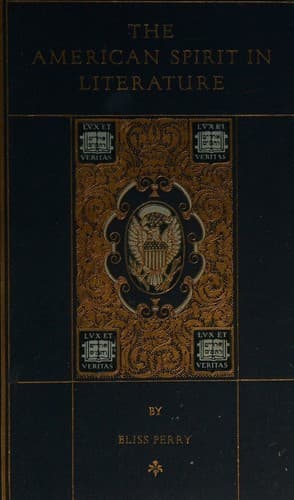
The American Spirit in Literature: A Chronicle of Great InterpretersPerry, Bliss
History
The American Spirit in Literature: A Chronicle of Great Interpreters
Perry, Bliss
American literature -- History and criticism
The legacy of guilt is likewise the theme of The House of the Seven
Gables, which Hawthorne himself was inclined to think a better book than
The Scarlet Letter. Certainly this story of old Salem is impeccably
written and its subtle handling of tone and atmosphere is beyond
dispute. An ancestral curse, the visitation of the sins of the fathers
upon the children, the gradual decay of a once sound stock, are motives
that Ibsen might have developed. But the Norseman would have failed to
rival Hawthorne's delicate manipulation of his shadows, and the no less
masterly deftness of the ultimate mediation of a dark inheritance
through the love of the light-hearted Phœbe for the latest descendant of
the Maules. In The Blithedale Romance Hawthorne stood for once, perhaps,
too near his material to allow the rich atmospheric effects which he
prefers, and in spite of the unforgetable portrait of Zenobia and
powerful passages of realistic description, the book is not quite
focussed. In The Marble Faun Hawthorne comes into his own again. Its
central problem is one of those dark insoluble ones that he loves: the
influence of a crime upon the development of a soul. Donatello, the
Faun, is a charming young creature of the natural sunshine until his
love for the somber Miriam tempts him to the commission of murder: then
begins the growth of his mind and character. Perhaps the haunting power
of the main theme of the book has contributed less to its fame than the
felicity of its descriptions of Rome and Italy. For Hawthorne possessed,
like Byron, in spite of his defective training in the appreciation of
the arts, a gift of romantic discernment which makes The Marble Faun,
like Childe Harold, a glorified guide-book to the Eternal City.
All of Hawthorne's books, in short, have a central core of psychological
romance, and a rich surface finish of description. His style, at its
best, has a subdued splendor of coloring which is only less wonderful
than the spiritual perceptions with which this magician was endowed. The
gloom which haunts many of his pages, as I have said elsewhere, is the
long shadow cast by our mortal destiny upon a sensitive soul. The
mystery is our mystery, perceived, and not created, by that finely
endowed mind and heart. The shadow is our shadow; the gleams of insight,
the soft radiance of truth and beauty, are his own.
Public-domain text, read in full here on John Shaqi.
Reviews
Reviews
No reviews yet
Be the first to share your thoughts on this work.
Elsewhere in the archive
Join the Discussion
Join the discussion
Sign in to leave a comment or review.
Sign InorCreate an account