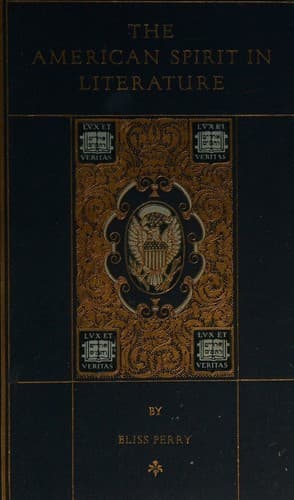
The American Spirit in Literature: A Chronicle of Great InterpretersPerry, Bliss
History
The American Spirit in Literature: A Chronicle of Great Interpreters
Perry, Bliss
American literature -- History and criticism
A college classmate of Henry Wadsworth Longfellow summed up the Portland
boy's character in one sentence: "It appeared easy for him to avoid the
unworthy." Born in 1807, of Mayflower stock that had distinguished
itself for bravery and uprightness, the youth was graduated from Bowdoin
at eighteen. Like his classmate Hawthorne, he had been a wide and
secretly ambitious reader, and had followed the successive numbers of
Irving's Sketch Book, he tells us, "with ever increasing wonder and
delight." His college offered him in 1826 a professorship of the modern
languages, and he spent three happy years in Europe in preparation. He
taught successfully at Bowdoin for five or six years, and for eighteen
years, 1836 to 1854, served as George Ticknor's successor at Harvard,
ultimately surrendering the chair to Lowell. He early published two
prose volumes, Hyperion and Outre-mer, Irvingesque romances of European
travel. Then came, after ten years of teaching and the death of his
young wife, the sudden impulse to write poetry, and he produced, "softly
excited, I know not why," The Reaper and the Flowers, a Psalm of Death.
From that December morning in 1838 until his death in 1882 he was
Longfellow the Poet.
His outward life, like Hawthorne's, was barren of dramatic incident,
save the one tragic accident by which his second wife, the mother of his
children, perished before his eyes in 1861. He bore the calamity with
the quiet courage of his race and breeding. But otherwise his days ran
softly and gently, enriched with books and friendships, sheltered from
the storms of circumstance. He had leisure to grow ripe, to remember,
and to dream. But he never secluded himself, like Tennyson, from normal
contacts with his fellowmen. The owner of the Craigie House was a good
neighbor, approachable and deferential. He was even interested in local
Cambridge politics. On the larger political issues of his day his
Americanism was sound and loyal. "It is disheartening," he wrote in his
Cambridge journal for 1851, "to see how little sympathy there is in the
hearts of the young men here for freedom and great ideas." But his own
sympathy never wavered. His linguistic talent helped him to penetrate
the secrets of alien ways of thought and speech. He understood Italy and
Spain, Holland and France and Germany. He had studied them on the lips
of their living men and women and in the books where soldier and
historian, priest and poet, had inscribed the record of five hundred
years. From the Revival of Learning to the middle of the nineteenth
century, Longfellow knew the soul of Europe as few men have known it,
and he helped to translate Europe to America. His intellectual
receptivity, his quick eye for color and costume and landscape, his ear
for folk-lore and ballad, his own ripe mastery of words, made him the
most resourceful of international interpreters. And this lover of
children, walking in quiet ways, this refined and courteous host and
Public-domain text, read in full here on John Shaqi.
Reviews
Reviews
No reviews yet
Be the first to share your thoughts on this work.
Elsewhere in the archive
Join the Discussion
Join the discussion
Sign in to leave a comment or review.
Sign InorCreate an account