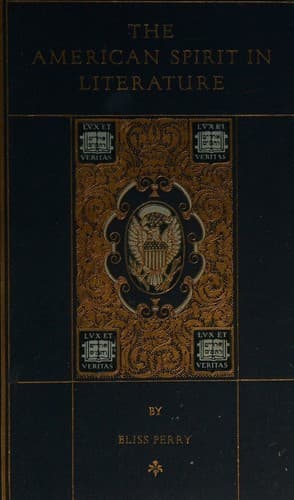
The American Spirit in Literature: A Chronicle of Great InterpretersPerry, Bliss
History
The American Spirit in Literature: A Chronicle of Great Interpreters
Perry, Bliss
American literature -- History and criticism
Springfield, My Lost Youth, The Children's Hour, and many another lyric,
lose nothing with the lapse of time. There is fortunately infinite room
for personal preference in this whole matter of poetry, but the
confession of a lack of regard for Longfellow's verse must often be
recognized as a confession of a lessening love for what is simple,
graceful, and refined. The current of contemporary American taste,
especially among consciously clever, half-trained persons, seems to be
running against Longfellow. How soon the tide may turn, no one can say.
Meanwhile he has his tranquil place in the Poet's Corner of Westminster
Abbey. The Abbey must be a pleasant spot to wait in, for the Portland
boy.
Oddly enough, some of the over-sophisticated and under-experienced
people who affect to patronize Longfellow assume toward John Greenleaf
Whittier an air of deference. This attitude would amuse the Quaker poet.
One can almost see his dark eyes twinkle and the grim lips tighten in
that silent laughter in which the old man so much resembled Cooper's
Leather-Stocking. Whittier knew that his friend Longfellow was a better
artist than himself, and he also knew, by intimate experience as a maker
of public opinion, how variable are its judgments.
Whittier represents a stock different from that of the Longfellows, but
equally American, equally thoroughbred: the Essex County Quaker farmer
of Massachusetts. The homestead in which he was born in 1807, at East
Haverhill, had been built by his great-great-grandfather in 1688. Mount
Vernon in Virginia and the Craigie House in Cambridge are newer than
this by two generations. The house has been restored to the precise
aspect it had in Whittier's boyhood: and the garden, lawn, and brook,
even the door-stone and bridle-post and the barn across the road are
witnesses to the fidelity of the descriptions in Snow-Bound. The
neighborhood is still a lonely one. The youth grew up in seclusion, yet
in contact with a few great ideas, chief among them Liberty. "My
father," he said, "was an old-fashioned Democrat, and really believed in
the Preamble of the Bill of Rights which reaffirmed the Declaration of
Independence." The taciturn father transmitted to his sons a hatred of
kingcraft and priestcraft, the inward moral freedom of the Quaker
touched with humanitarian passion. The spirit of a boyhood in this
homestead is veraciously told in The Barefoot Boy, School-Days,
Snow-Bound, Ramoth Hill, and Telling the Bees. It was a chance copy of
Burns that revealed to the farmer lad his own desire and capacity for
verse-writing. When he was nineteen, his sister sent his Exile's
Departure to William Lloyd Garrison, then twenty, and the editor of the
Newburyport Free Press. The neighbors liked it, and the tall frail
author was rewarded with a term at the Haverhill Academy, where he paid
his way, in old Essex County fashion, by making shoes.
Public-domain text, read in full here on John Shaqi.
Reviews
Reviews
No reviews yet
Be the first to share your thoughts on this work.
Elsewhere in the archive
Join the Discussion
Join the discussion
Sign in to leave a comment or review.
Sign InorCreate an account