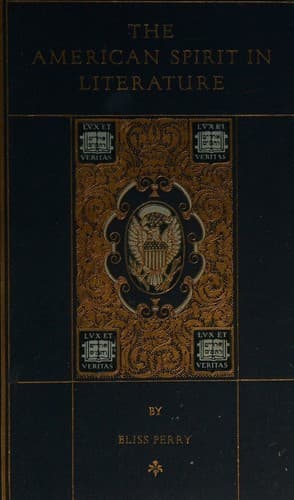
The American Spirit in Literature: A Chronicle of Great InterpretersPerry, Bliss
History
The American Spirit in Literature: A Chronicle of Great Interpreters
Perry, Bliss
American literature -- History and criticism
gentleman, scholar and poet, exemplified without self-advertisement the
richer qualities of his own people. When Couper's statue of Longfellow
was dedicated in Washington, Hamilton Mabie said: "His freedom from the
sophistication of a more experienced country; his simplicity, due in
large measure to the absence of social self-consciousness; his tranquil
and deep-seated optimism, which is the effluence of an unexhausted soil;
his happy and confident expectation, born of a sense of tremendous
national vitality; his love of simple things in normal relations to
world-wide interests of the mind; his courage in interpreting those
deeper experiences which craftsmen who know art but who do not know life
call commonplaces; the unaffected and beautiful democracy of his
spirit--these are the delicate flowers of our new world, and as much a
part of it as its stretches of wilderness and the continental roll of
its rivers."
Longfellow's poetic service to his countrymen has thus become a national
asset, and not merely because in his three best known narrative poems,
Evangeline, Hiawatha, and The Courtship of Miles Standish, he selected
his themes from our own history. The Building of the Ship, written with
full faith in the troubled year of 1849, is a national anthem. "It is a
wonderful gift," said Lincoln, as he listened to it, his eyes filled
with tears, "to be able to stir men like that." The Skeleton in Armor, A
Ballad of the French Fleet, Paul Revere's Ride, The Wreck of the
Hesperus, are ballads that stir men still. For all of his skill in
story-telling in verse--witness the Tales of a Wayside Inn--Longfellow
was not by nature a dramatist, and his trilogy now published under the
title of Christus, made up of The Divine Tragedy, The Golden Legend, and
New England Tragedies, added little to a reputation won in other fields.
His sonnets, particularly those upon Chaucer, Milton, The Divina
Commedia, A Nameless Grave, Felton, Sumner, Nature, My Books, are among
the imperishable treasures of the English language. In descriptive
pieces like Keramos and The Hanging of the Crane, in such personal and
occasional verses as The Herons of Elmwood, The Fiftieth Birthday of
Agassiz, and the noble Morituri Salutamus written for his classmates in
1875, he exhibits his tenderness of affection and all the ripeness of
his technical skill. But it was as a lyric poet, after all, that he won
and held his immense audience throughout the English-speaking world. Two
of the most popular of all his early pieces, The Psalm of Life and
Excelsior, have paid the price of a too apt adjustment to the ethical
mood of an earnest moment in our national life. We have passed beyond
them. And many readers may have outgrown their youthful pleasure in
Maidenhood, The Rainy Day, The Bridge, The Day is Done, verses whose
simplicity lent themselves temptingly to parody. Yet such poems as The
Belfry of Bruges, Seaweed, The Fire of Driftwood, The Arsenal at
Public-domain text, read in full here on John Shaqi.
Reviews
Reviews
No reviews yet
Be the first to share your thoughts on this work.
Elsewhere in the archive
Join the Discussion
Join the discussion
Sign in to leave a comment or review.
Sign InorCreate an account