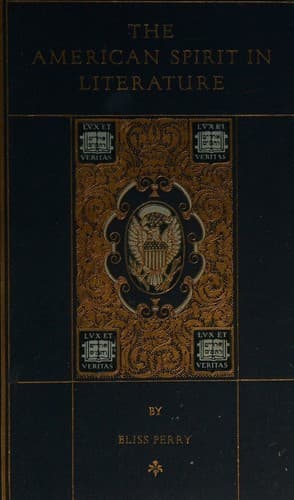
The American Spirit in Literature: A Chronicle of Great InterpretersPerry, Bliss
History
The American Spirit in Literature: A Chronicle of Great Interpreters
Perry, Bliss
American literature -- History and criticism
When The Atlantic Monthly was established in 1857, Whittier was fifty.
He took his place among the contributors to the new magazine not as a
controversialist but as a man of letters, with such poems as Tritemius,
and Skipper Ireson's Ride. Characteristic productions of this period are
My Psalm, Cobbler Keezar's Vision, Andrew Rykman's Prayer, The Eternal
Goodness--poems grave, sweet, and tender. But it was not until the
publication of Snow-Bound in 1866 that Whittier's work touched its
widest popularity. He had never married, and the deaths of his mother
and sister Elizabeth set him brooding, in the desolate Amesbury house,
over memories of his birthplace, six miles away in East Haverhill. The
homestead had gone out of the hands of the Whittiers, and the poet,
nearing sixty, set himself to compose an idyll descriptive of the
vanished past. No artist could have a theme more perfectly adapted to
his mood and to his powers. There are no novel ideas in Snow-Bound, nor
is there any need of them, but the thousands of annual pilgrims to the
old farmhouse can bear witness to the touching intimacy, the homely
charm, the unerring rightness of feeling with which Whittier's genius
recreated his own lost youth and painted for all time a true New England
hearthside.
Whittier was still to write nearly two hundred more poems, for he lived
to be eighty-five, and he composed until the last. But his creative
period was now over. He rejoiced in the friendly recognition of his work
that came to him from every section of a reunited country. His personal
friends were loyal in their devotion. He followed the intricacies of
American politics with the keen zest of a veteran in that game, for in
his time he had made and unmade governors and senators. "The greatest
politician I have ever met," said James G. Blaine, who had certainly met
many. He had an income from his poems far in excess of his needs, but
retained the absolute simplicity of his earlier habits. When his
publishers first proposed the notable public dinner in honor of his
seventieth birthday he demurred, explaining to a member of his family
that he did not want the bother of "buying a new pair of pants"--a petty
anecdote, but somehow refreshing. So the rustic, shrewd, gentle old man
waited for the end. He had known what it means to toil, to fight, to
renounce, to eat his bread in tears, and to see some of his dreams come
true. We have had, and shall have, more accomplished craftsmen in verse,
but we have never bred a more genuine man than Whittier, nor one who had
more kinship with the saints.
Public-domain text, read in full here on John Shaqi.
Reviews
Reviews
No reviews yet
Be the first to share your thoughts on this work.
Elsewhere in the archive
Join the Discussion
Join the discussion
Sign in to leave a comment or review.
Sign InorCreate an account