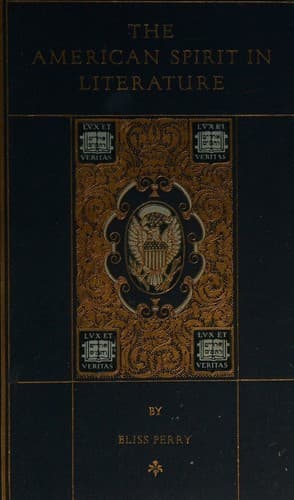
The American Spirit in Literature: A Chronicle of Great InterpretersPerry, Bliss
History
The American Spirit in Literature: A Chronicle of Great Interpreters
Perry, Bliss
American literature -- History and criticism
A few days before Whittier's death, he wrote an affectionate poem in
celebration of the eighty-third birthday of his old friend of the
Saturday Club, Dr. Oliver Wendell Holmes. This was in 1892. The little
Doctor, rather lonely in his latest years, composed some tender obituary
verses at Whittier's passing. He had already performed the same office
for Lowell. He lingered himself until the autumn of 1894, in his
eighty-sixth year--The Last Leaf, in truth, of New England's richest
springtime.
"No, my friends," he had said in The Autocrat of the Breakfast Table, "I
go (always, other things being equal) for the man who inherits family
traditions and the cumulative humanities of at least four or five
generations." The Doctor came naturally by his preference for a "man of
family," being one himself. He was a descendant of Anne Bradstreet, the
poetess. "Dorothy Q.," whom he had made the most picturesque of the
Quincys, was his great-grandmother. Wendell Phillips was his cousin. His
father, the Rev. Abiel Holmes, a Yale graduate, was the minister of the
First Church in Cambridge, and it was in its "gambrel-roofed" parsonage
that Oliver Wendell was born in 1809.
Know old Cambridge? Hope you do.--
Born there? Don't say so! I was, too.
• • • • • • • •
Nicest place that was ever seen--
Colleges red and Common green.
So he wrote, in scores of passages of filial devotion, concerning the
village of his boyhood and the city of Boston. His best-known prose
sentence is: "Boston State House is the hub of the Solar System." It is
easy to smile, as indeed he did himself, at such fond provinciality, but
the fact remains that our literature as a whole sadly needs this
richness of local atmosphere. A nation of restless immigrants, here
today and "moved on" tomorrow, has the fibres of its imagination
uprooted, and its artists in their eager quest of "local color" purchase
brilliancy at the cost of thinness of tone, poverty of association.
Philadelphia and Boston, almost alone among the larger American cities,
yield the sense of intimacy, or what the Autocrat would call "the
cumulative humanities."
Public-domain text, read in full here on John Shaqi.
Reviews
Reviews
No reviews yet
Be the first to share your thoughts on this work.
Elsewhere in the archive
Join the Discussion
Join the discussion
Sign in to leave a comment or review.
Sign InorCreate an account