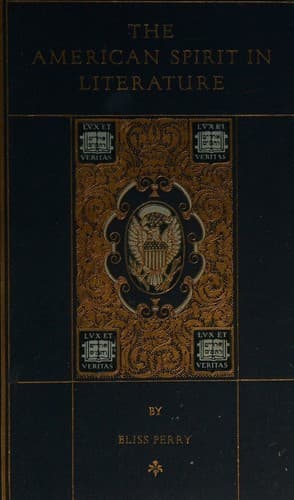
The American Spirit in Literature: A Chronicle of Great InterpretersPerry, Bliss
History
The American Spirit in Literature: A Chronicle of Great Interpreters
Perry, Bliss
American literature -- History and criticism
The Conspiracy of Pontiac, a highly-colored narrative in two volumes
appearing in 1851, marks the first stage of his historical writing. Then
came the tragedy of shattered health, and for fourteen years Parkman
fought for life and sanity, and produced practically nothing. He had had
to struggle from his college days with an obscure disorder of the brain,
aggravated by the hardships of his Oregon Trail journey, and by
ill-considered efforts to harden his bodily frame by over-exertion. His
disease took many forms--insomnia, arthritis, weakness of sight,
incapacity for sustained thought. His biographer Farnham says that "he
never saw a perfectly well day during his entire literary career." Even
when aided by secretaries and copyists, six lines a day was often the
limit of his production. His own Stoic words about the limitations of
his eyesight are characteristic: "By reading for one minute, and then
resting for an equal time, this alternate process may gradually be
continued for about half an hour. Then, after a sufficient interval, it
may be repeated, often three or four times in the course of the day. By
this means nearly the whole of the volume now offered has been
composed." There is no more piteous or inspiring story of a fight
against odds in the history of literature.
For after his fortieth year the enemy gave way a little, and book after
book somehow got itself written. There they stand upon the shelves, a
dozen of them--The Pioneers of France, The Jesuits in North America, La
Salle, The Old Régime, Frontenac, Montcalm and Wolfe, A Half-Century of
Conflict--the boy's dream realized, the man's long warfare accomplished.
The history of the forest, as Parkman saw it, was a pageant with the
dark wilderness for a background, and, for the actors, taciturn savages,
black-robed Jesuits, intrepid explorers, soldiers of France--all
struggling for a vast prize, all changing, passing, with a pomp and
color unknown to wearied Europe. It was a superb theme, better after all
for an American than the themes chosen by Prescott and Ticknor and
Motley, and precisely adapted to the pictorial and narrative powers of
the soldier-minded, soldier-hearted author.
Public-domain text, read in full here on John Shaqi.
Reviews
Reviews
No reviews yet
Be the first to share your thoughts on this work.
Elsewhere in the archive
Join the Discussion
Join the discussion
Sign in to leave a comment or review.
Sign InorCreate an account