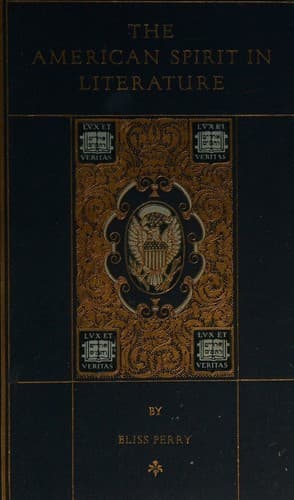
The American Spirit in Literature: A Chronicle of Great InterpretersPerry, Bliss
History
The American Spirit in Literature: A Chronicle of Great Interpreters
Perry, Bliss
American literature -- History and criticism
The quality which Parkman admired most in men--though he never seems to
have loved men deeply, even his own heroes--was strength of will. That
was the secret of his own power, and the sign, it must be added, of the
limitations of this group of historians who came at the close of the
golden age. Whatever a New England will can accomplish was wrought
manfully by such admirable men as Prescott and Parkman. Trained
intelligence, deliberate selection of subject, skillful cultivation of
appropriate story-telling and picture-painting style, all these were
theirs. But the "wild ecstasy" that thrilled the young Emerson as he
crossed the bare Common at sunset, the "supernal beauty" of which Poe
dreamed in the Fordham cottage, the bay horse and hound and turtle-dove
which Thoreau lost long ago and could not find in his hut at Walden,
these were something which our later Greeks of the New England Athens
esteemed as foolishness.
CHAPTER VIII.
Poe and Whitman
Enter now two egotists, who have little in common save their egotism,
two outsiders who upset most of the conventional American rules for
winning the literary race, two men of genius, in short, about whom we
are still quarreling, and whose distinctive quality is more accurately
perceived in Europe than it has ever been in the United States.
Both Poe and Whitman were Romanticists by temperament. Both shared in
the tradition and influence of European Romanticism. But they were also
late comers, and they were caught in the more morbid and extravagant
phases of the great European movement while its current was beginning to
ebb. Their acquaintance with its literature was mainly at second-hand
and through the medium of British and American periodicals. Poe, who was
older than Whitman by ten years, was fifteen when Byron died, in 1824.
He was untouched by the nobler mood of Byron, though his verse was
colored by the influence of Byron, Moore, and Shelley. His prose models
were De Quincey, Disraeli, and Bulwer. Yet he owed more to Coleridge
than to any of the Romantics. He was himself a sort of Coleridge without
the piety, with the same keen penetrating critical intelligence, the
same lovely opium-shadowed dreams, and, alas, with something of the same
reputation as a dead-beat.
Public-domain text, read in full here on John Shaqi.
Reviews
Reviews
No reviews yet
Be the first to share your thoughts on this work.
Elsewhere in the archive
Join the Discussion
Join the discussion
Sign in to leave a comment or review.
Sign InorCreate an account