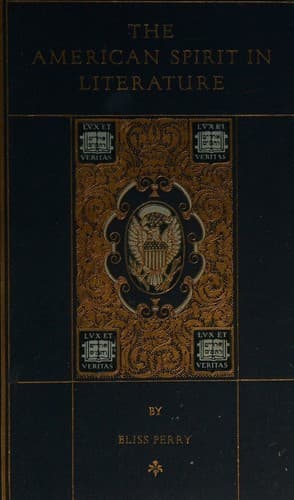
The American Spirit in Literature: A Chronicle of Great InterpretersPerry, Bliss
History
The American Spirit in Literature: A Chronicle of Great Interpreters
Perry, Bliss
American literature -- History and criticism
loves to pose as a man without imagination and with "habits of rigid
thought." And there are tales of conscience, of which The Black Cat is
the most fearful and William Wilson the most subtle; and there are
landscape sketches and fantasies and extravaganzas, most of these poor
stuff.
It is ungrateful and perhaps unnecessary to dwell upon Poe's
limitations. His scornful glance caught certain aspects of the human
drama with camera-like precision. Other aspects of life, and nobler, he
never seemed to perceive. The human comedy sometimes moved him to
laughter, but his humor is impish and his wit malign. His imagination
fled from the daylight; he dwelt in the twilight among the tombs. He
closed his eyes to dream, and could not see the green sunlit earth,
seed-time and harvest, man going forth to his toil and returning to his
hearthstone, the America that laughs as it labors. He wore upon his
finger the magic ring and the genii did his bidding. But we could wish
that the palaces they reared for him were not in such a somber land,
with such infernal lights gleaming in their windows, and crowded with
such horror-haunted forms. We could wish that his imagination dealt less
often with those primitive terrors that belong to the childhood of our
race. Yet when his spell is upon us we lapse back by a sort of atavism
into primal savagery and shudder with a recrudescence of long forgotten
fears. No doubt Poe was ignorant of life, in the highest sense. He was
caged in by his ignorance, Yet he had beautiful dusky wings that bruised
themselves against his prison.
Poe was a tireless critic of his own work, and both his standards of
workmanship and his critical precepts have been of great service to his
careless countrymen. He turned out between four and five short stories a
year, was poorly paid for them, and indeed found difficulty in selling
them at all. Yet he was constantly correcting them for the better. His
best poems were likewise his latest. He was tantalized with the desire
for artistic perfection. He became the pathbreaker for a long file of
men in France, Italy, England, and America. He found the way and they
brought back the glory and the cash.
Public-domain text, read in full here on John Shaqi.
Reviews
Reviews
No reviews yet
Be the first to share your thoughts on this work.
Elsewhere in the archive
Join the Discussion
Join the discussion
Sign in to leave a comment or review.
Sign InorCreate an account