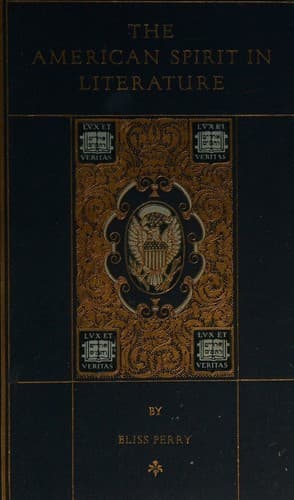
The American Spirit in Literature: A Chronicle of Great InterpretersPerry, Bliss
History
The American Spirit in Literature: A Chronicle of Great Interpreters
Perry, Bliss
American literature -- History and criticism
I have sometimes imagined Poe, with four other men and one woman, seated
at a dinner-table laid for six, and talking of their art and of
themselves. What would the others think of Poe? I fancy that Thackeray
would chat with him courteously, but would not greatly care for him.
George Eliot, woman-like, would pity him. Hawthorne would watch him with
those inscrutable eyes and understand him better than the rest. But
Stevenson would be immensely interested; he would begin an essay on Poe
before he went to sleep. And Mr. Kipling would look sharply at him: he
has seen that man before, in The Gate of a Hundred Sorrows. All of them
would find in him something to praise, a great deal to marvel at, and
perhaps not much to love. And the sensitive, shabby, lonely Poe--what
would he think of them? He might not care much for the other guests, but
I think he would say to himself with a thrill of pride: "I belong at
this table." And he does.
Walt Whitman, whom his friend O'Connor dubbed the "good gray poet,"
offers a bizarre contrast to Edgar Allan Poe. There was nothing
distinctively American about Poe except his ingenuity; he had no
interest in American history or in American ideas; he was a timeless,
placeless embodiment of technical artistry. But Whitman had a passion
for his native soil; he was hypnotized by the word America; he spent
much of his mature life in brooding over the question, "What, after all,
is an American, and what should an American poet be in our age of
science and democracy?" It is true that he was as untypical as Poe of
the average citizen of "these states." His personality is unique. In
many respects he still baffles our curiosity. He repels many of his
countrymen without arousing the pity which adds to their romantic
interest in Poe. Whatever our literary students may feel, and whatever
foreign critics may assert, it must be acknowledged that to the vast
majority of American men and women "good old Walt" is still an outsider.
Public-domain text, read in full here on John Shaqi.
Reviews
Reviews
No reviews yet
Be the first to share your thoughts on this work.
Elsewhere in the archive
Join the Discussion
Join the discussion
Sign in to leave a comment or review.
Sign InorCreate an account