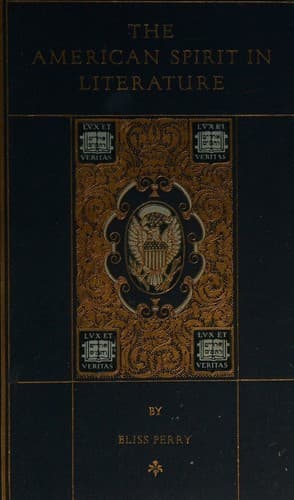
The American Spirit in Literature: A Chronicle of Great InterpretersPerry, Bliss
History
The American Spirit in Literature: A Chronicle of Great Interpreters
Perry, Bliss
American literature -- History and criticism
Let us try to see first the type of mind with which we are dealing. It
is fundamentally religious, perceiving the unity and kinship and glory
of all created things. It is this passion of worship which inspired St.
Francis of Assisi's Canticle to the Sun. It cries, "Benedicite, Omnia
opera Domini: All ye Green Things upon the Earth, bless ye the Lord!"
That is the real motto for Whitman's Leaves of Grass. Like St. Francis,
and like his own immediate master, Ralph Waldo Emerson, Whitman is a
mystic. He cannot argue the ultimate questions; he asserts them. Instead
of marshaling and sifting the proofs for immortality, he chants "I know
I am deathless." Like Emerson again, Whitman shares that peculiarly
American type of mysticism known as Transcendentalism, but he came at
the end of this movement instead of at the beginning of it. In his
Romanticism, likewise, he is an end of an era figure. His affiliations
with Victor Hugo are significant; and a volume of Scott's poems which he
owned at the age of sixteen became his "inexhaustible mine and treasury
for more than sixty years." Finally, and quite as uncompromisingly as
Emerson, Thoreau, and Poe, Whitman is an individualist. He represents
the assertive, Jacksonian period of our national existence. In a
thousand similes he makes a declaration of independence for the separate
person, the "single man" of Emerson's Phi Beta Kappa address. "I wear my
hat as I please, indoors and out." Sometimes this is mere swagger.
Sometimes it is superb.
So much for the type. Let us turn next to the story of Whitman's life.
It must here be told in the briefest fashion, for Whitman's own prose
and poetry relate the essentials of his biography. He was born on Long
Island, of New England and Dutch ancestry, in 1819. Lowell, W. W. Story,
and Charles A. Dana were born in that year, as was also George Eliot.
Whitman's father was a carpenter, who "leaned to the Quakers." There
were many children. When little "Walt"--as he was called, to distinguish
him from his father, Walter--was four, the family moved to Brooklyn. The
boy had scanty schooling, and by the time he was twenty had tried
type-setting, teaching, and editing a country newspaper on Long Island.
He was a big, dark-haired fellow, sensitive, emotional, extraordinarily
impressible.
Public-domain text, read in full here on John Shaqi.
Reviews
Reviews
No reviews yet
Be the first to share your thoughts on this work.
Elsewhere in the archive
Join the Discussion
Join the discussion
Sign in to leave a comment or review.
Sign InorCreate an account