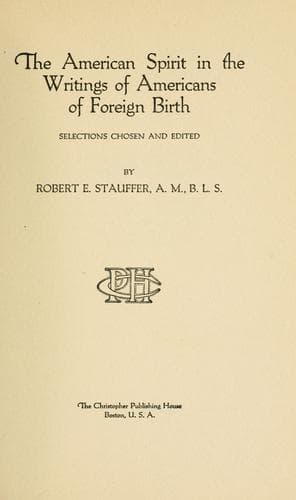
The American Spirit in the Writings of Americans of Foreign Birth
General
The American Spirit in the Writings of Americans of Foreign Birth
American literature; Americanization; Noncitizens -- United States
While calling at the old basement bookshop on East Broadway I suddenly
heard a horrible wailing and lamenting on the street. A funeral
procession was hurrying by, followed by several women in an open
carriage. Their hair was flying, their faces were red with weeping,
their bodies were swaying grotesquely to the rhythm of their violent
cries. The oldest in the group continued mechanically to address the
body in the hearse: “Husband dear, upon whom have you left us? Upon
whom, husband dear?” A young girl facing her in the vehicle looked
about in a terrified manner, seized every now and then the hand of her
afflicted mother, and tried to quiet her. The frightful scene, with
its tragic display, its abysmal ludicrousness, its barbarous noise,
revolted me. I had seen the like of it before, but that was in another
life. I had once been part of such a performance myself, and the grief
of it still lingered somewhere in my motley soul. But now I could only
think of the affecting simplicity, the quiet, unobtrusive solemnity of
a burial I had witnessed the previous spring in the West.
The afternoon following my arrival I flew uptown to see Esther. She
waved to me and smiled as I approached--she had been waiting on the
“stoop.” As she shook my hand in her somewhat masculine fashion, she
took me in with a glance, and the first thing she said was: “What a
genteel person you have become! You have changed astonishingly.” “Do
you think so?” I asked her. “I am afraid I haven’t. At least they do
not think so in Missouri.” Then she told me that she had got only ten
points, but that she was expecting three more in the fall. She was
almost resigned to wait another year before entering college. That
would enable her to make her total requirements, save up a little more
money, and get her breath. “A woman is not a man, you know,” she added.
“I am beginning to feel the effects of it all. I am really exhausted.
Geometry has nearly finished me. And mother has added her share. She is
no longer young, and this winter she was ill. I have worried and I have
had to send money. But let us not talk about my troubles. You are full
of things to tell me, I know.”
Public-domain text, read in full here on John Shaqi.
Reviews
Reviews
No reviews yet
Be the first to share your thoughts on this work.
Elsewhere in the archive
Join the Discussion
Join the discussion
Sign in to leave a comment or review.
Sign InorCreate an account