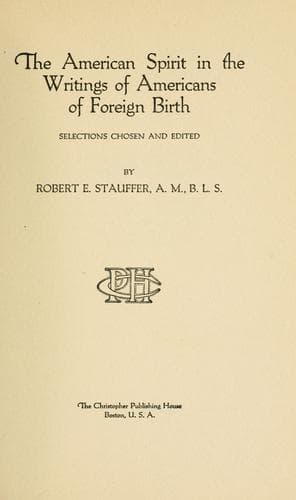
The American Spirit in the Writings of Americans of Foreign Birth
General
The American Spirit in the Writings of Americans of Foreign Birth
American literature; Americanization; Noncitizens -- United States
And in the fall I went back--this time a week _before_ college
opened--and was met by Harvey at the station, just as those
rural-looking boys had been met by their friends the year before. When
I reached the campus, I was surprised to see how many people knew me.
Scores of them came up and slapped me on the back and shook hands in
their hearty, boisterous fashion, and hoped that I had had a jolly
summer. I was asked to join boarding-clubs, to become a member in
debating societies, to come and see this fellow or that in his room.
It took me off my feet, this sudden geniality of my fellows toward me.
I had not been aware how, throughout the previous year, the barriers
between us had been gradually and steadily breaking down. It came
upon me all at once. I felt my heart going out to my new friends. I
had become one of them. I was not a man without a country. I was an
American.
ELIZABETH G. STERN
The pathos of the readjustment of the foreign-born to the new life in
America has nowhere been more touchingly presented than in the story,
“My Mother and I,” by Mrs. E. G. Stern, who was born in Russian
Poland.
Anyone who has gone on a long journey to make his home far from
friends and relatives knows something of the pain of separating from
loved ones; but the pain of such a separation cannot compare with
the travail of taking a far spiritual journey. That one may still
have deep reverence for the past, though breaking away from it, is
the conviction of the author, who says: “And I shall always remember
that, though my life is now part of my land’s, yet, if I am truly
part of America, it was mother, she who does not understand America,
who made me so. I wonder if, as the American mother I strive to be, I
can find a finer example than my own mother!”
THE PATHOS OF READJUSTMENT
AUTHOR’S PURPOSE IN WRITING
The mere writing of this account is a chain, slight, but never to be
broken; one that will always bind me to that from which I had thought
myself forever cut off. For I am writing not only of myself. In myself
I see one hundred thousand young men and women with dark eyes aflame
with enthusiasm, or blue eyes alight with hope. In myself, as I write
this record, I see the young girl whose father plucked oranges in
Italian gardens, the maiden whose mother worked on still mornings in
the wide fields of Poland, the young man whose grandmother toiled in
the peat bogs of Ireland. I am writing this for myself and for those
who, like me, are America’s foster children, to remind us of them,
through whose pioneer courage the bright gates of this beautiful land
of freedom were opened to us, and upon whose tumuli of gray and weary
years of struggle we, their children, rose to our opportunities.
I am writing to those sons and daughters of immigrant fathers and
mothers who are now in America, and to those who will come after this
devastating war to America, and to those who will receive them.
MARRIAGE AND AFTER
Public-domain text, read in full here on John Shaqi.
Reviews
Reviews
No reviews yet
Be the first to share your thoughts on this work.
Elsewhere in the archive
Join the Discussion
Join the discussion
Sign in to leave a comment or review.
Sign InorCreate an account