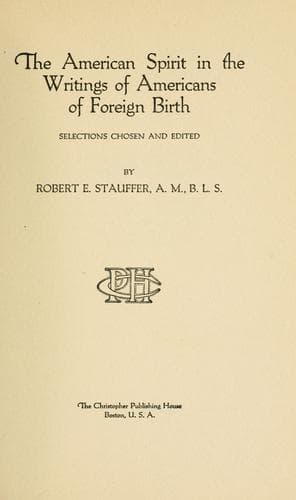
The American Spirit in the Writings of Americans of Foreign Birth
General
The American Spirit in the Writings of Americans of Foreign Birth
American literature; Americanization; Noncitizens -- United States
I went to school, father went to work, mother looked after the house.
When evening came, instead of sitting about the fire, talking and
reliving the day, we sat, each in his own corner. One nursed his tired
bones, another prepared his lessons for the morrow. The demands of
the school devoured me; the work world exhausted my father. The long
evenings of close contact with my home people were becoming rare. I was
slipping away from my home; home was slipping away from me.
Yet my father knew what he was about. While the fathers of most of the
boys about me were putting their money into business or into their
houses, mine put his strength, his love, his money, his comforts into
making me better than himself. The spirit of the crusaders should live
again in his son. He wanted me to become a priest: I wanted to become a
doctor.
During all the years that he worked for me, I worked for myself. While
his hopes were centred in the family, mine were extending beyond it.
I worked late into the nights, living a life of which my father was
not a part. This living by myself tended to make me forget, indeed to
undervalue, the worth of my people. I was ashamed sometimes because my
folk did not look or talk like Americans.
When most depressed by the feeling of living crudely and poorly, I
would go out to see my father at work. I would see him high up on a
scaffold a hundred feet in the air, and my head would get dizzy and my
heart would rise to my throat. Then I would think of him once more as
the poet story-teller with the strong, soothing voice and the far-off
visioned eye, and would see why on two-dollar-a-day wages he sent me to
college.
Proud of his strength, I would strengthen my moral fibre and respond to
his dream. Yet not as he dreamed; for when he fell fifty feet down a
ladder and was ill for a whole year, I went to work at teaching.
AN IMMIGRANT AND THE CHILDREN
The schools will change for the better when their life is made
basically different from what it has been.
They are pointed in the direction of the fundamentals of knowledge,
but working with the tools of the classicists. They have developed
and developed until we find life on one side,--that is, outside the
school,--and learning on the other side,--that is, inside the school.
Now the schools must be pointed so that life and the school become one.
To begin with, better school conditions must be provided for the
youngest children. The first steps in child teaching must be sound. The
primary years of school must be worth while. Unless the basic structure
is real, soul satisfying, higher education will be halting and futile.
The child is entitled to a fine start in his life’s journey if he is to
have a fair chance of carrying his head high and his shoulders straight.
Public-domain text, read in full here on John Shaqi.
Reviews
Reviews
No reviews yet
Be the first to share your thoughts on this work.
Elsewhere in the archive
Join the Discussion
Join the discussion
Sign in to leave a comment or review.
Sign InorCreate an account