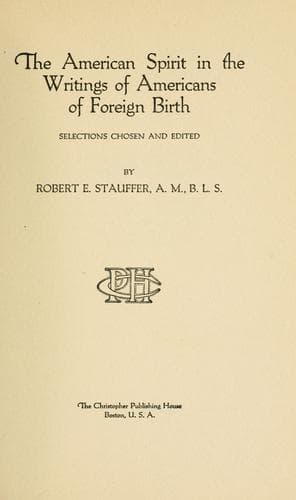
The American Spirit in the Writings of Americans of Foreign Birth — John Shaqi
The American Spirit in the Writings of Americans of Foreign Birth
General
The American Spirit in the Writings of Americans of Foreign Birth
American literature; Americanization; Noncitizens -- United States
How seldom is it that history affords us the example of a voluntary
sacrifice on the part of separate communities to further the common
good! It appears to me that the short history of America furnishes us
with more examples of this kind than that of any other nation, ancient
or modern. Throughout the war of the Revolution, and for some years
preceding it, the public feeling may be said to have been unusually
excited. At such times, men, and societies of men, are equal to actions
beyond the strength of their virtue at cooler moments. Passing on,
therefore, to the peace of 1783, we find a number of independent
republics gradually reconciling their separate and clashing interests,
each yielding something to promote the advantage of all, and sinking
the pride of individual sovereignty in that of the united whole. The
remarks made by Ramsay on the adoption of the federal constitution are
so apposite that I cannot resist quoting them:
“The adoption of this constitution was a triumph of virtue and good
sense over the vices and follies of human nature; in some respects, the
merit of it is greater than that of the Declaration of Independence.
The worst of men can be urged to make a spirited resistance to invasion
of their rights; but higher grades of virtue are requisite to induce
freemen, in the possession of a limited sovereignty, voluntarily to
surrender a portion of their natural liberties; to impose on themselves
those restraints of good government which bridle the ferocity of man,
compel him to respect the claims of others, and to submit his rights
and his wrongs to be decided upon by the voices of his fellow citizens.
The instances of nations which have vindicated their liberty by the
sword are many; of those which have made a good use of their liberty
when acquired are comparatively few.”
Nor did the liberality of these republics evince itself only in the
adoption of the general government. We find some making voluntary
concessions of vast territories, that they might be devoted to national
purposes; others releasing part of their own people from existing
engagements, and leaving them to consult their wishes and convenience
by forming themselves into new communities.
Should we contrast this policy with that employed by other nations,
we might hastily pronounce this people to be singularly free from
the ordinary passions of humanity. But, no; they are only singularly
enlightened in the art of government; they have learned that there is
no strength without union, no union without good fellowship, and no
good fellowship without fair dealing; and, having learned this, they
are only singularly fortunate in being able to reduce their knowledge
to practice.
FOOTNOTE:
Public-domain text, read in full here on John Shaqi.
Reviews
Reviews
No reviews yet
Be the first to share your thoughts on this work.
Join the Discussion
Join the discussion
Sign in to leave a comment or review.
Sign InorCreate an account