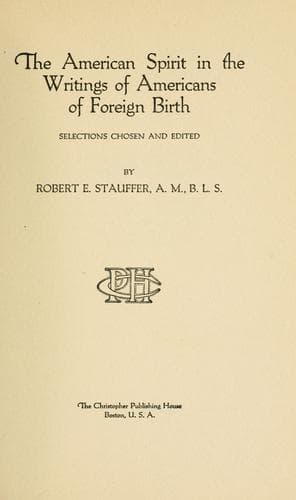
The American Spirit in the Writings of Americans of Foreign Birth
General
The American Spirit in the Writings of Americans of Foreign Birth
American literature; Americanization; Noncitizens -- United States
There are some, however, who, while acknowledging that the love of
distinction will retain its force under every form of social or
political organization, yet maintain that to excel in the arts,
science, or literature requires leisure, and the possession of
leisure implies the possession of fortune. This men in a democratic
society cannot have, because the absence of great hereditary wealth
is necessary to the perpetuation of democracy. Every man, or nearly
every man, must toil for a living; and therefore it becomes impossible
for him to gratify the thirst for distinction, let him feel it ever so
strongly. The attention he can give to literature or art or science
must be too desultory and hasty, his mental training too defective, to
allow him to work out valuable results or conduct important researches.
To achieve great things in these fields, it is said and insinuated,
men must be elevated, by the possession of fortune, above the vulgar,
petty cares of life; their material wants must be provided for before
they concentrate their thoughts with the requisite intensity on the
task before them. Therefore it is to aristocracy we must look for any
great advance in these pursuits.
The history of literature and art and philosophy is, however, very far
from lending confirmation to this opinion. If it teaches us anything,
it teaches us that the possession of leisure, far from having helped
men in the pursuit of knowledge, seems to have impeded them. Those who
have pursued it most successfully are all but invariably those who
have pursued it under difficulties. The possession of great wealth no
doubt gives facilities for study and cultivation which the mass of
mankind do not possess; but it at the same time exerts an influence on
the character which, in a vast majority of cases, renders the owner
unwilling to avail himself of them. We owe to the Roman aristocracy
the great fabric of Roman jurisprudence; but, since their time, what
has any aristocracy done for art and literature, or law? They have for
over a thousand years been in possession of nearly the whole resources
of every country in Europe. They have had its wealth, its libraries,
its archives, its teachers, at their disposal; and yet was there ever
a more pitiful record than the list of “Royal and Noble Authors.”
One can hardly help being astonished, too, at the smallness and
paltriness of the legacies which the aristocracy of the aristocratic
age has bequeathed to this democratic age which is succeeding it. It
has, indeed, handed down to us many glorious traditions, many noble
and inspiring examples of courage and fortitude and generosity. The
democratic world would certainly be worse off than it is if it never
heard of the Cid, or Bayard, or Du Guesclin, of Montrose, or Hampden,
or Russell. But what has it left behind it for which the lover of art
may be thankful, by which literature has been made richer, philosophy
more potent or more fruitful? The painting and sculpture of modern
Public-domain text, read in full here on John Shaqi.
Reviews
Reviews
No reviews yet
Be the first to share your thoughts on this work.
Join the Discussion
Join the discussion
Sign in to leave a comment or review.
Sign InorCreate an account