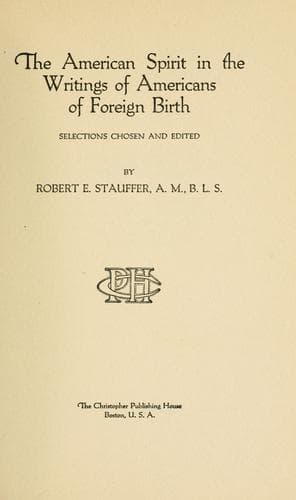
The American Spirit in the Writings of Americans of Foreign Birth
General
The American Spirit in the Writings of Americans of Foreign Birth
American literature; Americanization; Noncitizens -- United States
Yet I am sure that we cannot teach these strangers the history of their
adopted country, and make it their own, unless we teach them that our
history is theirs as well as ours, and that their traditions are ours,
at least as far as they touch humanity generally, and convey to all
men the blessings which come from the struggle against oppression and
superstition.
In their inherited, national prejudices, in their racial hates, in
their tribal quarrels, we wish to have no share, except as we hope to
help them forget the old world hates in the new world’s love.
None of us who have caught a vision of what America may mean to the
world wish to perpetuate here any one phase of Europe’s civilization or
any one national ideal.
Although our institutions are rooted in English history, though we
speak England’s language and share her rich heritage of spiritual and
cultural wealth, we do not desire to be again a part of England, or
nourish here her ideals of an aristocratic society.
In spite of the fact that for nearly three hundred years a large part
of our population has been German, and that our richest cultural
values have come from Germany, in spite of her marvellous resources in
science, commerce and government, we do not care to become German, and
I am sure that Americans of German blood or birth would be the first to
repudiate it, should Germany’s civilization threaten to fasten itself
upon us.
We do not wish to be Russian, in spite of certain values inherent in
the Slavic character, nor do we desire to be French.
We do crave to be an American people--and develop here an American
civilization; but if we are true to the manifold genius of our varied
peoples, we may develop here a civilization, richer and freer than any
of these, based upon all of them, truly international and therefore
American.
Historians tell us that the history of the United States illumines and
illustrates the historic processes of all ages and all people.
To this they add the disconcerting prophecy that we are drifting
towards the common goal, and that our doleful future can be readily
foretold. We have had our hopeful morning, our swift and brilliant
noon, and now the dark and gruesome end threatens us.
I will not believe this till I must.
I will not, dare not lose the hope that we can make this country to
endure firmly, to weather the storm, or at least put off the senility
of old age to the last inevitable moment.
When, however, the end comes, as perhaps it must, I pray that we may
project our hopes and ideals upon the last page of our history, so that
it may read thus: This was a state, the first to grow by the conquest
of nature, and not of nations. Here was developed a commerce based upon
service, and not upon selfishness; a religion centering in humanity and
not in a church.
Here was maintained sovereignty without a sovereign, and here the
people of all nations grew into one nation, held together by mutual
regard, not by the force of law.
Public-domain text, read in full here on John Shaqi.
Reviews
Reviews
No reviews yet
Be the first to share your thoughts on this work.
Elsewhere in the archive
Join the Discussion
Join the discussion
Sign in to leave a comment or review.
Sign InorCreate an account