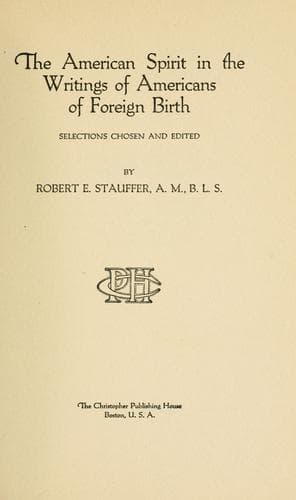
The American Spirit in the Writings of Americans of Foreign Birth
General
The American Spirit in the Writings of Americans of Foreign Birth
American literature; Americanization; Noncitizens -- United States
America wants the immigrant as a worker; but does it make any effort
to direct him, to distribute him to the places where workers are
needed? No; it leaves the immigrant to go here, there, any place. If
the immigrant were a horse instead of a human being, America would be
more careful of him; if it loses a horse, it feels it loses something;
if it loses an immigrant, it feels it loses nothing. At any rate, that
is the way it seems to the immigrant; and it strengthens his natural
disposition to settle among people of his own race.
A man needs to be a fighter to come to America without friends. I was
more fortunate than many: I had a brother in America. He worked in
a private bank. He met me when I landed and took me to his home in
Brooklyn. I looked for a job for about a month. I tried to get work on
the Italian newspapers; I tried to get work in a law office. Finally
a friend took me to a Jewish law office, and I was employed--I was
to get 25 per cent. of the fees from any clients that I brought in.
I stayed there two months and got $5. Three months after I arrived
in New York I was given the kind of a place that I had looked for in
vain in my native land--one that would enable me to support myself and
study my chosen profession. I was given a place on an Italian religious
newspaper. I worked from eight in the morning to six in the evening,
and attended the night course of the New York Law School.
It was about August when I landed in America, and already there was
election talk. (It was the year McClellan ran for Mayor.) I met some
of the Italian-American politicians. It is said that I have a gift for
oratory. The politicians asked what would be my price to talk in the
Italian sections of the city. I said that I did not want anything. I
made speeches for McClellan, and I have made speeches in every campaign
since.
That was one of the first things that struck me in America--that every
one working in politics was working for his own pocket. Another thing
that also amazed me was that most of the men elected to an office,
in which they are supposed to deliberate and legislate, were in
reality only figureheads taking orders from some one else. They had no
independence, no individuality. Another discovery was that the Italians
with most political influence were men of low morality, of low type.
Then I discovered the reason: the politicians needed repeaters and
guerillas, and that was why “the boss had to be seen” through a saloon-
or dive-keeper.
Public-domain text, read in full here on John Shaqi.
Reviews
Reviews
No reviews yet
Be the first to share your thoughts on this work.
Elsewhere in the archive
Join the Discussion
Join the discussion
Sign in to leave a comment or review.
Sign InorCreate an account