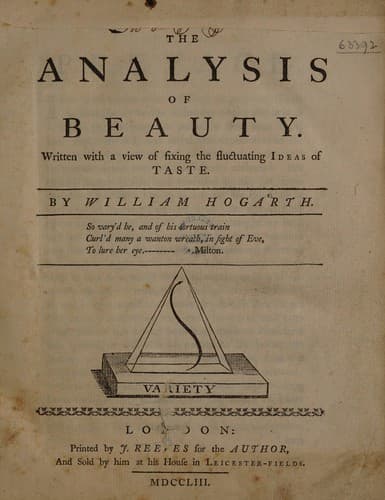
The Analysis of Beauty: Written with a view of fixing the fluctuating ideas of tasteHogarth, William
Philosophy
The Analysis of Beauty: Written with a view of fixing the fluctuating ideas of taste
Hogarth, William
Aesthetics -- Early works to 1800
Windsor castle is a noble instance of the effect of quantity. The
hugeness of its few distinct parts strikes the eye with uncommon
grandeur at a distance, as well as nigh. It is quantity, with
simplicity, which makes it one of the finest objects in the kingdom,
tho' void of any regular order of architecture.
The Façade of the old Louvre at Paris is also remarkable for its
quantity. This fragment is allow'd to be the finest piece of building
in France, tho' there are many equal, if not superior, to it in all
other respects, except that of quantity.
Who does not feel a pleasure when he pictures in his mind the immense
buildings which once adorn'd the lower Egypt, by imagining the whole
complete, and ornamented with colossal statues?
Elephants and whales please us with their unwieldy greatness. Even
large personages, merely for being so, command respect: nay, quantity
is an addition to the person which often supplies a deficiency in his
figure.
The robes of state are always made large and full, because they give
a grandeur of appearance, suitable to the offices of the greatest
distinction. The judge's robes have an awful dignity given them by the
quantity of their contents, and when the train is held up, there is a
noble waving line descending from the shoulders of the judge to the
hand of his train-bearer. So when the train is gently thrown aside, it
generally falls into a great variety of folds, which again employ the
eye, and fix its attention.
The grandeur of the Eastern dress, which so far surpasses the European,
depends as much on quantity as on costliness.
In a word, it is quantity which adds greatness to grace. But then
excess is to be avoided, or quantity will become clumsy, heavy, or
ridiculous.
[Illustration: Fig. 16]
The full-bottom wig, like the lion's mane, hath something noble in
it, and adds not only dignity, but sagacity to the countenance [fig.
16 p. I]: but were it to be worn as large again, it would become a
burlesque; or were an improper person to put it on, it would then too
be ridiculous.
When improper, or _incompatible_ excesses meet, they always excite
laughter; more especially when the forms of those excesses are
inelegant, that is, when they are composed of unvaried lines.
[Illustration: Figs. 17 and 18]
For example, the figure refer'd to in the margin [Fig. 17 p. I],
represents a fat grown face of a man, with an infant's cap on, and the
rest of the child's dress stuff'd, and so well placed under his chin,
as to seem to belong to that face. This is a contrivance I have seen at
Bartholomew-fair, and always occasion'd a roar of laughter. The next
[Fig. 18 p. I] is of the same kind, a child with a man's wig and cap
on. In these you see the ideas of youth and age jumbled together, in
forms without beauty.
[Illustration: Fig. 19]
Public-domain text, read in full here on John Shaqi.
Reviews
Reviews
No reviews yet
Be the first to share your thoughts on this work.
Join the Discussion
Join the discussion
Sign in to leave a comment or review.
Sign InorCreate an account