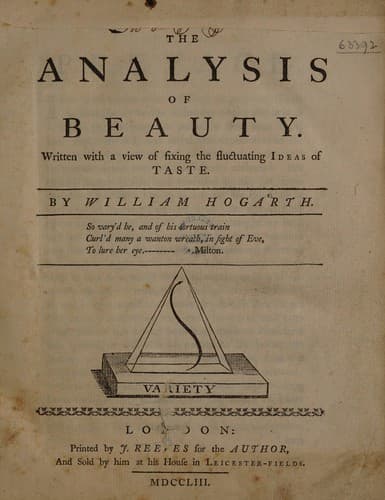
The Analysis of Beauty: Written with a view of fixing the fluctuating ideas of tasteHogarth, William
Philosophy
The Analysis of Beauty: Written with a view of fixing the fluctuating ideas of taste
Hogarth, William
Aesthetics -- Early works to 1800
This sort of form may be seen with yet more variations, (and therefore
more beautiful) in the goat's horn, from which, in all probability, the
ancients originally took the extremely elegant forms they have given
their cornu-copias.
There is another way of considering this last figure of the horn I
would recommend to my reader, in order to give him a clearer idea of
the use both of the waving and serpentine-lines in composition.
This is to imagine the horn, thus bent and twisted, to be cut
length-ways by a very fine saw into two equal parts; and to observe
one of these in the same position the whole horn is represented in;
and these two observations will naturally occur to him. First, that
the edge of the saw must run from one end to the other of the horn
in the line of beauty; so that the edges of this half of the horn
will have a beautiful shape: and, secondly, that wherever the dotted
serpentine-line on the surface of the whole horn dips behind, and is
lost to the eye, it immediately comes into sight on the hollow surface
of the divided horn.
The use I shall make of these observations will appear very
considerable in the application of them to the human form, which we are
next to attempt.
It will be sufficient, therefore, at present only to observe, first,
that the whole horn acquires a beauty by its being thus genteely bent
two different ways; secondly, that whatever lines are drawn on its
external surface become graceful, as they must all of them, from the
twist that is given the horn, partake in some degree or other, of the
shape of the serpentine-line: and, lastly, when the horn is split, and
the inner, as well as the outward surface of its shell-like form is
exposed, the eye is peculiarly entertained and relieved in the pursuit
of these serpentine-lines, as in their twistings their concavities
and convexities are alternately offer'd to its view. Hollow forms,
therefore, composed of such lines are extremely beautiful and pleasing
to the eye; in many cases more so, than those of solid bodies.
Almost all the muscles, and bones, of which the human form is
composed, have more, or less of these kind of twists in them; and give
in a less degree, the same kind of appearance to the parts which cover
them, and are the immediate object of the eye: and for this reason it
is that I have been so particular in describing these forms of the
bent, and twisted, and ornamented horn.
Public-domain text, read in full here on John Shaqi.
Reviews
Reviews
No reviews yet
Be the first to share your thoughts on this work.
Join the Discussion
Join the discussion
Sign in to leave a comment or review.
Sign InorCreate an account