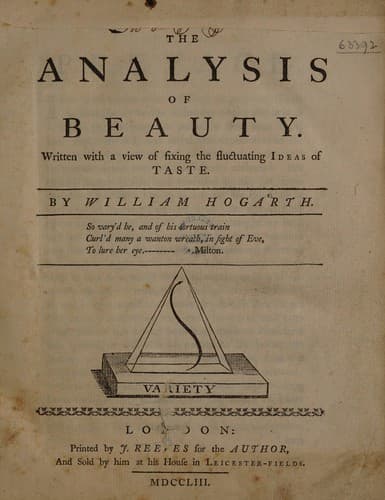
The Analysis of Beauty: Written with a view of fixing the fluctuating ideas of tasteHogarth, William
Philosophy
The Analysis of Beauty: Written with a view of fixing the fluctuating ideas of taste
Hogarth, William
Aesthetics -- Early works to 1800
I have call'd it the retiring shade, because by the successive,
or continual change in its appearance, it is equally instrumental
with converging lines[13], in shewing how much objects, or any parts
of them, retire or recede from the eye; without which, a floor, or
horizontal-plane, would often seem to stand upright like a wall. And
notwithstanding all the other ways by which we learn to know at what
distances things are from us, frequent deceptions happen to the eye on
account of deficiencies in this shade: for if the light chances to be
so disposed on objects as not to give this shade its true gradating
appearance, not only spaces are confounded, but round things appear
flat, and flat ones round.
[13] See p. 17. The two converging lines from the ship, to the point C,
under fig. 47, plate I.
[Illustration: Fig. 94]
But although the retiring shade hath this property, when seen with
converging lines, yet if it describes no particular form, as none
of those do in fig. 94, on top of plate II, it can only appear as a
flat-pencil'd shade; but being inclosed within some known boundary or
out-line, such as may signify a wall, a road, a globe, or any other
form in perspective where the parts retire, it will then shew its
retiring quality: as for example, the retiring shade on the floor, in
plate II, which gradates from the dog's feet to those of the dancer's,
shews, that by this means a level appearance is given to the ground:
so when a cube is put into true perspective on paper, with lines only,
which do but barely hint the directions every face of it is meant to
take, these shades make them seem to retire just as the perspective
lines direct; thus mutually compleating the idea of those recessions
which neither of them alone could do.
[Illustration: gradated shade]
Moreover, the out-line of a globe is but a circle on the paper; yet,
according to the manner of filling up the space within it, with this
shade, it may be made to appear either flat, globular, or concave, in
any of its positions with the eye; and as each manner of filling up the
circle for those purposes must be very different, it evidently shews
the necessity of distinguishing this shade into as many species or
kinds, as there are classes or species of lines, with which they may
have a correspondence.
In doing which, it will be found, that, by their correspondency with,
and conformity to objects, either composed of straight, curved, waving,
or serpentine lines, they of course take such appearances of variety as
are adequate to the variety made by those lines; and by this conformity
of shades we have the same ideas of any of the objects composed of
the above lines in their front aspects, as we have of them by their
profiles; which otherwise could not be without feeling them.
Now instead of giving engraved examples of each species of shade, as I
have done of lines, I have found that they may be more satisfactorily
pointed out and described by having recourse to the life.
Public-domain text, read in full here on John Shaqi.
Reviews
Reviews
No reviews yet
Be the first to share your thoughts on this work.
Elsewhere in the archive
Join the Discussion
Join the discussion
Sign in to leave a comment or review.
Sign InorCreate an account