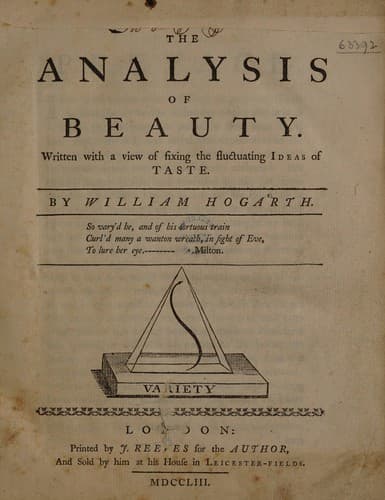
The Analysis of Beauty: Written with a view of fixing the fluctuating ideas of tasteHogarth, William
Philosophy
The Analysis of Beauty: Written with a view of fixing the fluctuating ideas of taste
Hogarth, William
Aesthetics -- Early works to 1800
The other shades that have been before spoken of, serve and help to
the like purposes when properly opposed; but as in nature they are
continually fleeting and changing their appearances, either by our or
their situations, they sometimes oppose and relieve, and sometimes not,
as for instance; I once observed the tower-part of a steeple so exactly
the colour of a light cloud behind it, that, at the distance I stood,
there was not the least distinction to be made, so that the spire (of a
lead-colour) seemed suspended in the air; but had a cloud of the like
tint with the steeple, supplied the place of the white one, the tower
would then have been relieved and distinct, when the spire would have
been lost to the view.
Nor is it sufficient that objects are of different colours or shades,
to shew their distances from the eye, if one does not in part hide or
lay over the other, as in fig. 86.
[Illustration: Fig. 90]
For as fig. [90 T p. II] the two equal balls, tho' one were black and
the other white, placed on the separate walls, supposed distant from
each other twenty or thirty feet, nevertheless, may seem both to rest
upon one, if the tops of the walls are level with the eye; but when
one ball hides part of the other, as in the same figure, we begin
to apprehend they are upon different walls, which is determin'd by
the perspective[17]: hence you will see the reason, why the steeple
of Bloomsbury-church, in coming from Hampstead, seems to stand upon
Montague-house, tho' it is several hundred yards distant from it.
[17] The knowledge of perspective is no small help to the seeing
objects truly, for which purpose Dr. Brook Taylor's Linear perspective
made easy to those who are unacquainted with geometry, proposed to be
publish'd soon by Mr. Kirby of Ipswich, may be of most service.
Since then the opposition of one prime tint or shade to another,
hath so great a share in marking out the recessions, or distances in
a prospect, by which the eye is led onward step by step, it becomes a
principle of consequence enough to be further discussed, with regard to
the management of it in compositions of nature, as well as art. As to
the management of it, when seen only from one point, the artist hath
the advantage over nature, because such fix'd dispositions of shades as
he hath artfully put together, cannot be displaced by the alteration
of light, for which reason, designs done in two prime tints only, will
sufficiently represent all those recessions, and give a just keeping to
the representation of a prospect, in a print; whereas, the oppositions
in nature, depending, as has been before hinted, on accidental
situations and uncertain incidents, do not always make such pleasing
composition, and would therefore have been very often deficient, had
nature worked in two colours only; for which reason she hath provided
an infinite number of materials, not only by way of prevention, but to
add lustre and beauty to her works.
Public-domain text, read in full here on John Shaqi.
Reviews
Reviews
No reviews yet
Be the first to share your thoughts on this work.
Elsewhere in the archive
Join the Discussion
Join the discussion
Sign in to leave a comment or review.
Sign InorCreate an account