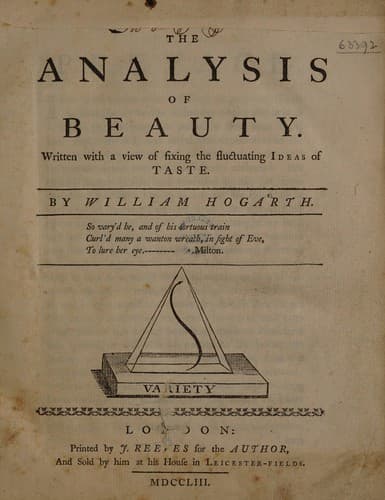
The Analysis of Beauty: Written with a view of fixing the fluctuating ideas of tasteHogarth, William
Philosophy
The Analysis of Beauty: Written with a view of fixing the fluctuating ideas of taste
Hogarth, William
Aesthetics -- Early works to 1800
By an infinite number of materials, I mean colours and shades of
all kinds and degrees; some notion of which variety may be formed by
supposing a piece of white silk by several dippings gradually dyed to
a black; and carrying it in like manner through the prime tints of
yellow, red, and blue; and then again, by making the like progress
through all the mixtures that are to be made of these three original
colours. So that when we survey this infinite and immense variety, it
is no wonder, that, let the light or objects be situated or changed
how they will, oppositions seldom miss; nor that even every incident
of shade should sometimes be so completely disposed as to admit of no
further beauty, as to composition; and from whence the artist hath by
observation taken his principles of imitation, as in the following
respect.
[Illustration: Fig. 89]
Those objects which are intended most to affect the eye, and come
forwardest to the view, must have large, strong, and smart oppositions,
like the fore-ground in fig. [89 p. II], and what are designed to be
thrown further off, must be made still weaker and weaker, as expressed
in figures 86, 92, and 93, which receding in order make a kind of
gradation of oppositions; to which, and all the other circumstances
already described, both for recession, and beauty, nature hath
added what is known by the name of aerial perspective; being that
interposition of air, which throws a general soft retiring tint over
the whole prospect; to be seen in excess at the rising of a fog. All
which again receives still more distinctness, as well as a greater
degree of variety, when the sun shines bright, and casts broad shadows
of one object upon another; which gives the skilful designer such hints
for shewing broad and fine oppositions of shades, as give life and
spirit to his performances.
[Illustration: Figs. 92 and 93]
BREADTH of SHADE is a principle that assists in making distinction
more conspicuous; thus fig. [87 p. I], is better distinguish'd by its
breadth or quantity of shade, and view'd with more ease and pleasure
at any distance, than fig. [88 p. I], which hath many, and these but
narrow shades between the folds. And for one of the noblest instances
of this, let Windsor-castle be viewed at the rising or setting of the
sun.
[Illustration: Figs. 87 and 88]
Let breadth be introduced how it will, it always gives great repose to
the eye; as on the contrary, when lights and shades in a composition
are scattered about in little spots, the eye is constantly disturbed,
and the mind is uneasy, especially if you are eager to understand every
object in the composition, as it is painful to the ear when any one is
anxious to know what is said in company, where many are talking at the
same time.
Public-domain text, read in full here on John Shaqi.
Reviews
Reviews
No reviews yet
Be the first to share your thoughts on this work.
Elsewhere in the archive
Join the Discussion
Join the discussion
Sign in to leave a comment or review.
Sign InorCreate an account