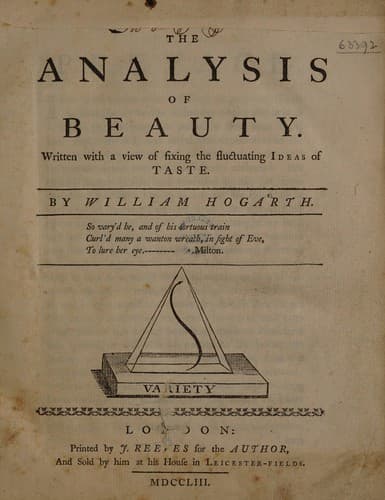
The Analysis of Beauty: Written with a view of fixing the fluctuating ideas of tasteHogarth, William
Philosophy
The Analysis of Beauty: Written with a view of fixing the fluctuating ideas of taste
Hogarth, William
Aesthetics -- Early works to 1800
It is well known, the fair young girl, the brown old man, and the
negro; nay, all mankind, have the same appearance, and are alike
disagreeable to the eye, when the upper skin is taken away: now to
conceal so disagreeable an object, and to produce that variety of
complexions seen in the world, nature hath contrived a transparent
skin, called the cuticula, with a lining to it of a very extraordinary
kind, called the cutis; both which are so thin any little scald
will make them blister and peel off. These adhering skins are more
or less transparent in some parts of the body than in others, and
likewise different in different persons. The cuticula alone is like
gold-beaters-skin, a little wet, but somewhat thinner, especially
in fair young people, which would shew the fat, lean, and all the
blood-vessels, just as they lie under it, as through Isinglass, were it
not for its lining the cutis, which is so curiously constructed, as to
exhibit those things beneath it which are necessary to life and motion,
in pleasing arrangements and dispositions of beauty.
The cutis is composed of tender threads like network, fill'd with
different colour'd juices. The white juice serves to make the very fair
complexion;--yellow, makes the brunnet;--brownish yellow, the ruddy
brown;--green yellow, the olive;--dark brown, the mulatto;--black, the
negro;--These different colour'd juices, together with the different
_meshes_ of the network, and the size of its threads in this or that
part, causes the variety of complexions.
A description of this manner of its shewing the rosy colour of the
cheek, and, in like manner, the bluish tints about the temple, &c. see
in the profile [fig. 95 T p. II], where you are to suppose the black
strokes of the print to be the white threads of the network, and where
the strokes are thickest, and the part blackest, you are to suppose the
flesh would be whitest; so that the lighter part of it stands for the
vermilion-colour of the cheek, gradating every way.
[Illustration: Fig. 95]
Some persons have the network so equally wove over the whole body, face
and all, that the greatest heat or cold will hardly make them change
their colour; and these are seldom seen to blush, tho' ever so bashful,
whilst the texture is so fine in some young women, that they redden, or
turn pale, on the least occasion.
I am apt to think the texture of this network is of a very tender
kind, subject to damage many ways, but able to recover itself again,
especially in youth. The fair fat healthy child of 3 or 4 years old
hath it in great perfection; most visible when it is moderately warm,
but till that age somewhat imperfect.
Public-domain text, read in full here on John Shaqi.
Reviews
Reviews
No reviews yet
Be the first to share your thoughts on this work.
Elsewhere in the archive
Join the Discussion
Join the discussion
Sign in to leave a comment or review.
Sign InorCreate an account