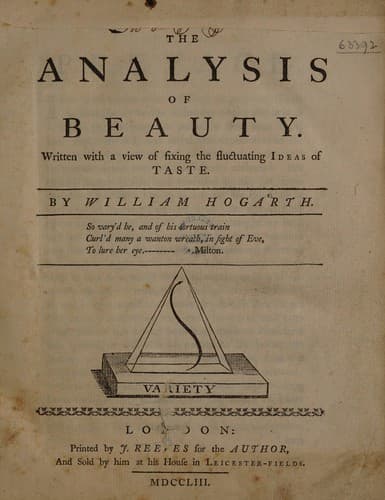
The Analysis of Beauty: Written with a view of fixing the fluctuating ideas of tasteHogarth, William
Philosophy
The Analysis of Beauty: Written with a view of fixing the fluctuating ideas of taste
Hogarth, William
Aesthetics -- Early works to 1800
[19] The lame excuse writers on painting have made for the many great
masters that have fail'd in this particular, is, that they purposely
deaden'd their colours, and kept them, what they affectedly call'd
_chaste_, that the correctness of their outlines might be seen to
greater advantage. Whereas colours cannot be too brillant if properly
disposed, because the distinction of the parts are thereby made more
perfect; as may be seen by comparing a marble busto with the variegated
colours of the face either in the life, or well painted: it is true,
uncomposed variety, either in the features or the limbs, as being
daubed with many, or one colour, will so confound the parts as to
render them unintelligible.
Rubens boldly, and in a masterly manner, kept his bloom tints bright,
separate, and distinct, but sometimes too much so for easel or cabinet
pictures; however, his manner was admirably well calculated for great
works, to be seen at a considerable distance, such as his celebrated
cieling at Whitehall-chapel[20]: which upon a nearer view, will
illustrate what I have advanc'd with regard to the separate brightness
of the tints; and shew, what indeed is known to every painter, that
had the colours there seen so bright and separate, been all smooth'd
and absolutely blended together, they would have produced a dirty grey
instead of flesh-colour. The difficulty then lies in bringing _blue_
the third original colour, into flesh, on account of the vast variety
introduced thereby; and this omitted, all the difficulty ceases; and a
common sign-painter that lays his colours smooth, instantly becomes, in
point of colouring, a Rubens, a Titian, or a Corregio.
[20] The front of this building by Inigo Jones, is an additional
exemplification of the principles for varying the parts in building;
(explained by the candlesticks, &c. Chapter VIII) which would appear
to be a stronger proof still, were a building formed of squares, on
squares; with squares uniformly cut in each square to be opposed to it,
to shew the reverse.
CHAPTER XV.
_Of the FACE_.
Having thus spoken briefly of light, shade, and colour, we now return
to our lineal account of form, as proposed (page 91) with regard to
the face. It is an observation, that, out of the great number of faces
that have been form'd since the creation of the world, no two have
been so exactly alike, but that the usual and common discernment of
the eye would discover a difference between them: therefore it is not
unreasonable to suppose, that this discernment is still capable of
further improvements by instructions from a methodical enquiry; which
the ingenious Mr. Richardson, in his treatise on painting, terms _the
art of seeing_.
[Illustration: Fig. 97]
Public-domain text, read in full here on John Shaqi.
Reviews
Reviews
No reviews yet
Be the first to share your thoughts on this work.
Elsewhere in the archive
Join the Discussion
Join the discussion
Sign in to leave a comment or review.
Sign InorCreate an account