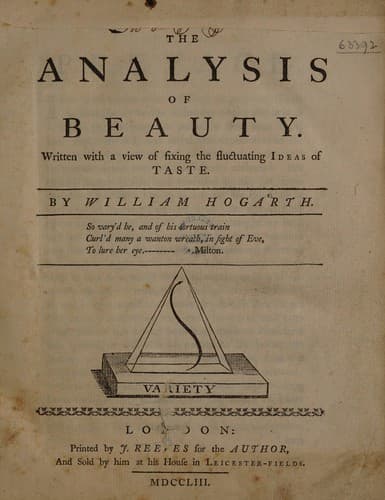
The Analysis of Beauty: Written with a view of fixing the fluctuating ideas of tasteHogarth, William
Philosophy
The Analysis of Beauty: Written with a view of fixing the fluctuating ideas of taste
Hogarth, William
Aesthetics -- Early works to 1800
1. I shall begin with a description of such lines as compose the
features of a face of the highest taste, and the reverse. See fig. [97,
B p. I], taken from an antique head, which stands in the first rank of
estimation: in proof of this, Raphael Urbin, and other great painters
and sculptors, have imitated it for the characters of their heroes
and other great men; and the old man's head, fig. [98, L p. I] was
model'd in clay, by Fiamingo (and not inferior in its taste of lines,
to the best antique) for the use of Andrea Sacchi, after which model he
painted all the heads in his famous picture of St. Romoaldo's dream;
and this picture hath the reputation of being one of the best pictures
in the world[21].
[21] Note, I must refer the reader to the casts of both these pieces
of sculpture, which are to be found in the hands of the curious;
because it is impossible to express all that I intend, with sufficient
accuracy, in a print of this size, whatever pains might have been taken
with it; or indeed in any print were it ever so large.
[Illustration: Fig. 98]
These examples are here chosen to exemplify and confirm the force
of serpentine lines in a face; and let it also be observed, that in
these master-pieces of art, all the parts are otherwise consistent
with the rules heretofore laid down: I shall therefore only shew the
effects and use of the line of beauty. One way of proving in what
manner the serpentine line appears to operate in this respect, may be
by pressing several pieces of wire close up and down the different
parts of the face and features of those casts; which wires will all
come off so many serpentine lines, as is partly marked in figure 97, by
the dotted lines. The beard and hair of the head, fig. 98, being a set
of loose lines naturally, and therefore disposable at the painter's or
sculptor's pleasure, are remarkably composed in this head of nothing
else but a varied play of serpentine lines, twisting together in a
flame-like manner.
But as imperfections are easier to be imitated than perfections, we
shall now have it in our power to explain the latter more fully; by
shewing the reverse in several degrees, down to the most contemptible
meanness that lines can be form'd into.
[Illustration: Figs. 99-105]
Figure 99, is the first degree of deviation from figure 97; where the
lines are made straighter, and reduced in quantity; deviating still
more in figure 100, more yet in figure 101, and yet more visibly in
102; figure 103, still more so; figure 104 is totally divested of all
lines of elegance, like a barber's block; and 105 is composed merely
of such plain lines as children make, when of themselves they begin to
imitate in drawing a human face. It is evident, the inimitable Butler
was sensible of the mean and ridiculous effect of such kind of lines,
by the description he gives of the shape of Hudibras's beard, fig. [106
L p. I],
In cut and dye so like a tile,
A sudden view it would beguile.
[Illustration: Fig. 106]
Public-domain text, read in full here on John Shaqi.
Reviews
Reviews
No reviews yet
Be the first to share your thoughts on this work.
Elsewhere in the archive
Join the Discussion
Join the discussion
Sign in to leave a comment or review.
Sign InorCreate an account